








You quoted $30,000 for a website redesign. Six months later, you’ve delivered a website, mobile app, three rounds of revisions you never agreed to, ongoing support you didn’t scope, and custom integrations that weren’t in the contract. Your total revenue? Still $30,000. Your actual profit after all the extra work? Maybe $5,000. You just worked for $17 an hour.
That’s scope creep. It’s the silent profit killer that turns profitable projects into break-even disasters. Most service business owners can’t accurately identify when scope creep is happening because it doesn’t arrive as one big request. It comes as a series of small, reasonable-sounding additions. “While you’re at it, can you also…” “This is a quick thing, right?” “I assumed this was included.”
What Is Scope Creep?
Scope creep is when the work you’re actually doing exceeds what you agreed to do, without a corresponding increase in what you’re being paid. It’s the gap between the scope statement you signed and the work you’re delivering. Every hour spent on out-of-scope work is an hour you’re not billing for, which directly destroys your profit margins.
A consulting project scoped at 40 hours for $8,000 has an effective rate of $200 per hour. If scope creep adds 20 hours of unbilled work, you’ve now worked 60 hours for $8,000. Your effective rate just dropped to $133 per hour. That’s a 33 percent margin reduction. Do that across ten projects per year and you’ve given away $40,000 in profit without realizing it.
You’re not losing money to market conditions or bad pricing. You’re losing it to unclear boundaries, fear of saying no, and agreements that don’t protect your scope. The profit is there. You’re just doing extra work for free.
The Hidden Cost of “Just One More Thing”
What if you could deliver exceptional service, keep clients thrilled, AND protect your profit margins? That’s not contradictory. It’s the result of setting clear boundaries before work begins and maintaining them throughout delivery. Scope creep isn’t inevitable. It’s preventable through three specific boundaries most service businesses never establish.
What Causes Scope Creep? The Two Most Common Reasons
Poorly Defined Scope Statements
Most service agreements are vague. “Website redesign” could mean anything. Does it include mobile optimization? Content migration? SEO? Third-party integrations? If your scope statement uses broad terms without specific deliverables, you’ve invited scope creep before work even starts. Clients will assume everything they imagine is included. You’ll assume they understand the limitations. Both of you are wrong.
Fear of Saying No
Service business owners fear that enforcing boundaries will damage client relationships or lead to lost business. So when a client asks for something outside scope, you say yes. Then they ask for another thing, and you say yes again. The client isn’t trying to exploit you. They simply don’t know where the boundary is because you’ve never drawn one. Every yes to out-of-scope work redefines the boundary further out.
How Common Is Scope Creep?
Research from the Project Management Institute shows that scope creep affects more than half of all projects across industries. For service businesses specifically, the problem is even more pronounced. A study of professional service firms found that 68 percent experience regular scope creep, with the average project expanding by 25 to 40 percent beyond the original scope without corresponding fee adjustments.
The financial impact is substantial. Service businesses experiencing frequent scope creep report profit margins 15 to 25 percentage points lower than those with effective scope management. For a business doing $500,000 in annual revenue, that difference represents $75,000 to $125,000 in lost profit every year.
You’re not alone if you’re experiencing this problem. But knowing it’s common doesn’t make it acceptable.
Is Scope Creep Happening in Your Business?

Answer these five questions honestly:
- Do you regularly work more hours on projects than you originally quoted or estimated?
- Do clients frequently ask for additions or changes without discussing whether those items require additional budget?
- Have you delivered work that wasn’t explicitly outlined in your agreement because it seemed expected or necessary?
- Do you find yourself saying yes to client requests even when you know they’re outside the original scope?
- Have your project margins decreased over time even though your pricing hasn’t changed?
If you answered yes to three or more of these questions, scope creep is actively eroding your profitability. If you answered yes to all five, you’re likely giving away 20 to 40 percent of your potential profit through unbilled scope expansion.
Real-World Examples Across Service Businesses
A marketing agency quoted $15,000 for a three-month campaign covering social media and email. The client asked for “quick blog posts” in month two. Then video scripts. Then podcast outlines. By month three, they were delivering six different content types for the same $15,000. Margin went from 40 percent to 12 percent.
A construction contractor bid $75,000 for a kitchen remodel covering cabinets, countertops, and flooring. The homeowner asked if they could “just move that wall while you’re here.” Then add recessed lighting. Then upgrade the backsplash. The contractor said yes each time to “keep the client happy.” Final cost to complete the project was $92,000. Revenue stayed at $75,000. They lost $17,000.
An accounting firm scoped year-end financials at $8,000. The client sent additional entities to include. Then requested custom reports not in the agreement. Then asked for monthly check-ins. The firm delivered everything without adjusting the fee. Effective hourly rate dropped from $250 to $140.
A consulting firm agreed to deliver a strategic plan for $12,000. The client asked them to also attend implementation meetings. Then facilitate team workshops. Then create training materials. The consultant spent 90 hours instead of the scoped 50 hours. Profit on the engagement went from $7,000 to $2,400.
The pattern repeats across industries. Scope creep doesn’t happen because clients are malicious. It happens because boundaries weren’t clear upfront and weren’t maintained during delivery.
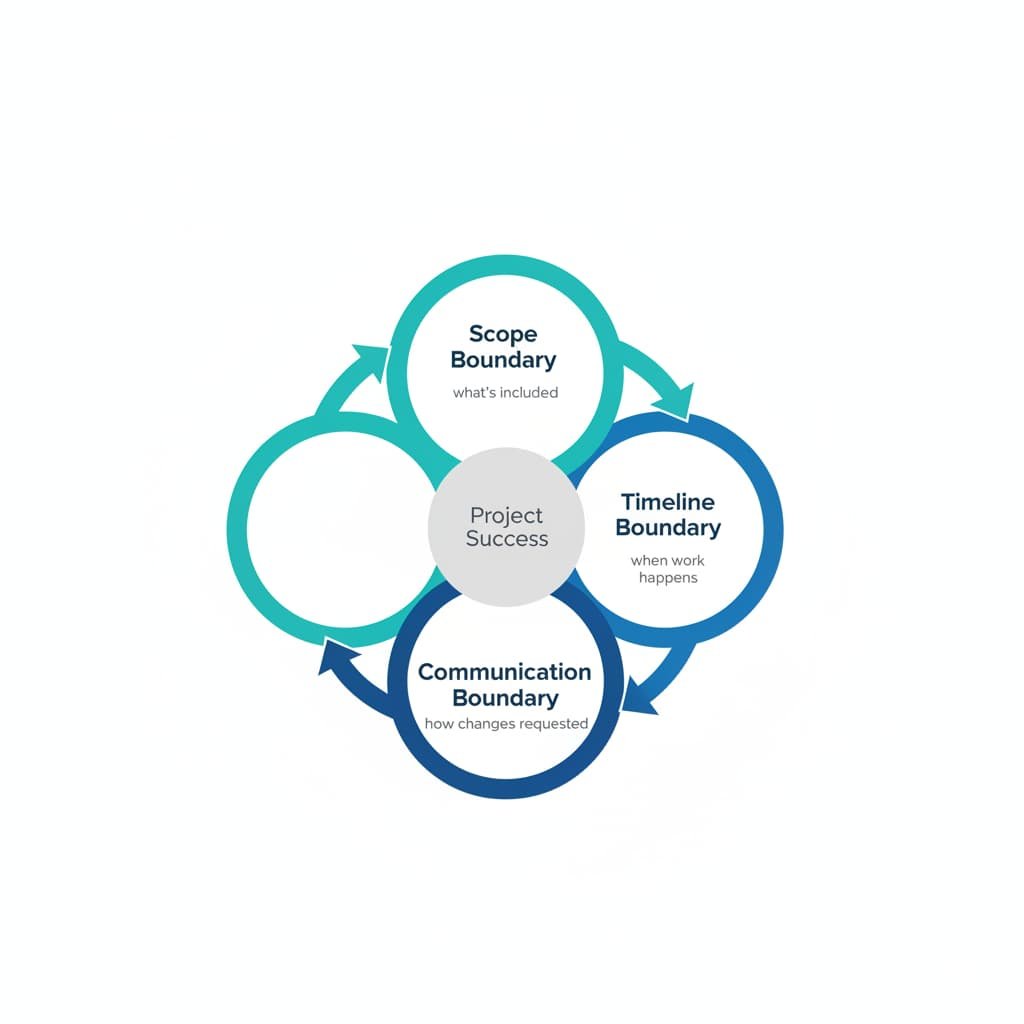
The 3 Boundaries That Stop Scope Creep
Preventing scope creep requires three distinct boundaries established before work begins and maintained throughout delivery. Most service businesses only think about the first boundary, what’s included, while completely ignoring the second two. The combination of all three creates a scope protection system that preserves margins without damaging client relationships.
Boundary 1: The Scope Boundary (What’s Included and What’s Not)
The scope boundary defines exactly what deliverables you will provide and, just as importantly, what you will not provide. Vague scope statements invite creep. Specific scope statements prevent it.
How to Define Your Scope Boundary
Start with deliverables, not activities. Don’t say “website development.” Say “15-page responsive website including: home, about, services (5 pages), blog (template only), contact, plus mobile optimization and basic SEO setup.” That’s specific. Everyone knows what’s included.
Then explicitly state what’s excluded. Add a section to your proposal: “This scope does not include: content writing, photography, video production, social media setup, email marketing integration, or third-party plugin customization.” By stating what’s NOT included, you eliminate assumptions.
Use a statement of work template that requires both parties to initial the scope section. This isn’t aggressive. It’s professional. Lawyers do this. Architects do this. You should too.
Sample Scope Statement Language: Before and After
Vague Scope Statement (Invites Creep): “Provide marketing services including social media management and content creation for three months.”
This statement guarantees scope creep. How many posts? Which platforms? What type of content? How many revisions? Everything is open to interpretation.
Specific Scope Statement (Prevents Creep): “Provide the following deliverables over three months:
- Social media management for Facebook and Instagram only (LinkedIn not included)
- 4 posts per week per platform (32 posts monthly, 96 total)
- Content creation limited to: static images with captions (video content not included)
- One round of revisions per post
- Monthly performance report (15-minute review call included)
Exclusions: This scope does not include paid advertising management, influencer outreach, email marketing, blog content, video production, photography services, or platform setup beyond existing accounts.”
The second version eliminates ambiguity. Both parties know exactly what they’re getting and what they’re not getting.
Real Application
A consulting firm changed their proposals from “strategic planning engagement” to “three 90-minute strategy sessions covering market positioning, pricing strategy, and growth roadmap, delivered via Zoom, with written summary document within 5 business days of final session.” Then added exclusions: “Does not include: implementation support, ongoing advisory, financial modeling, or competitive research beyond publicly available data.” Scope creep incidents dropped 70 percent in six months.
Boundary 2: The Timeline Boundary (When Work Happens)
The timeline boundary defines when work occurs, when deliverables are due, and when client input is required. Without this boundary, projects extend indefinitely as clients request additions “while you’re still working on it.”
How to Define Your Timeline Boundary
Specify project phases with hard end dates. Phase 1 ends on a date, not “when we finish the initial work.” If Phase 1 ends March 15th, any requests after March 10th go into Phase 2, which may require additional budget.
Build in client input windows. “Client feedback due by March 5th. Feedback received after this date will be incorporated in the next revision cycle.” This isn’t mean. It’s necessary to prevent endless revision loops.
Establish a change freeze date. For website launches, new app releases, or major deliverables, set a date after which no changes are accepted until after launch. Otherwise, you’ll never launch because clients keep adding “one more thing.”
Real Application
A web development agency implemented phase-based timelines. Design phase: 3 weeks. Development phase: 4 weeks. Testing phase: 2 weeks. Each phase had a hard end date. Client requests that came in during testing (“Can we add this feature?”) were automatically scoped into a post-launch Phase 2. This protected margins because Phase 2 had its own budget. Result: projects finished on time and on budget instead of dragging out indefinitely with unpaid additions.
Boundary 3: The Communication Boundary (How Changes Are Requested)
The communication boundary defines how clients request changes, how those requests are evaluated, and what the approval process looks like. Without this, every casual text message becomes a scope expansion.
How to Define Your Communication Boundary
Require change requests in writing through a specific channel. Email to a project management system. Submitted via a form. Not texts, not verbal mentions in meetings, not hallway conversations. If it’s not in writing in the designated channel, it’s not a formal request.
Implement a change order process. When a client requests something outside scope, don’t just say yes or no. Respond with: “That’s outside the current scope. I can provide a change order with timeline and cost for that addition.” This isn’t adversarial. It’s professional project management.
Evaluate requests against a simple filter: Does this request align with the original project goals? If yes, it might be a legitimate scope clarification. If no, it’s scope creep and requires a change order.
The Change Order Process: Step-by-Step
When a client requests work outside the agreed scope, follow this process:
Step 1: Acknowledge the Request Respond immediately to show you heard them: “Thanks for this request. I’ll review whether this is within our current scope or requires a change order and get back to you within 24 hours.”
Step 2: Evaluate Against Original Scope Compare the request to your signed agreement. Is it explicitly included? Explicitly excluded? Ambiguous? If it’s not clearly included, it requires a change order.
Step 3: Create the Change Order Document the requested work, estimated hours, cost, and timeline impact. A simple change order includes:
- Description of requested work
- Why it’s outside original scope (reference the specific scope section)
- Estimated additional hours required
- Additional fee (use your standard hourly rate or project rate)
- Timeline impact (will this delay final delivery?)
- Approval signature line
Step 4: Present to Client Send the change order with this language: “I’ve reviewed your request for [specific addition]. This work falls outside our current scope as outlined in section [X] of our agreement. I’m happy to add this work through the attached change order. The additional fee would be $[amount] and would add [X days/weeks] to our timeline. Please review and let me know if you’d like to proceed.”
Step 5: Document the Decision If they approve, both parties sign the change order and it becomes part of the project documentation. If they decline, document that the work was requested and declined. This prevents future disputes about what was or wasn’t included.
Sample Change Order Response Language:
“Hi [Client Name],
Thanks for the request to add [specific feature/deliverable]. I’ve reviewed this against our current scope, and this would be an addition to what we agreed to in our statement of work.
I’m happy to add this work. Based on my estimate, this would require approximately [X hours] of additional work at a cost of $[amount]. This would also extend our final delivery date by [X days/weeks].
I’ve attached a change order with the details. If you’d like to proceed, please review, sign, and return it, and I’ll add this to the project schedule.
If you’d prefer to keep the current scope and timeline as planned, that works too. Let me know what you’d like to do.
Thanks, [Your name]”
This language is professional, not confrontational. You’re not saying no. You’re saying “yes, and here’s what that looks like.”
Real Application
A professional services firm created a change request form requiring clients to answer three questions: (1) What are you requesting? (2) Why is this needed now? (3) What’s the priority compared to current scope? This simple form eliminated 60 percent of casual scope creep requests because clients realized they were asking for things outside the agreement. The remaining 40 percent were legitimate requests that got properly scoped and priced.
When Scope Change Is Strategic (Not All Expansion Is Bad)
Not all scope expansion is scope creep. Sometimes adding work makes strategic sense. The difference is intentionality and compensation.
Strategic scope expansion happens when the client requests an addition and you provide a change order with adjusted pricing. Or when you proactively identify an opportunity that benefits both parties and negotiate an additional fee. Or when the addition significantly increases the project’s value and you’re compensated accordingly.
Scope creep happens when work is added without corresponding fee adjustment. When you say yes out of fear rather than strategic choice. When the addition doesn’t serve the original project goals but you do it anyway.
The goal isn’t to never add scope. The goal is to never add unpaid scope. If scope changes, budget should change proportionally.
Calculate Your Scope Creep Tax
Scope creep doesn’t feel dramatic as it’s happening. A few extra hours here. One more revision there. But across a year, it’s the difference between profitable projects and working for minimum wage. A service business doing ten projects annually at $20,000 each with 30 percent margins should profit $60,000. Add 20 hours of scope creep per project at $150 per hour, and you’ve given away $30,000 in unbilled work. That cuts your profit in half.
The three boundaries work because they establish expectations before problems arise. Clients respect clear boundaries more than vague ones. They’d rather know upfront what’s included than discover limitations mid-project. The boundaries protect both parties. You deliver what was promised without resentment. They receive what they paid for without confusion.
March and April are when service businesses analyze first quarter project profitability and realize margins were lower than expected. The culprit is usually scope creep that went unnoticed during delivery.
Find Your Scope Creep Patterns
I’m currently interviewing service business owners for the second edition of Profit Foundation, my book on profit strategies for small businesses. During these 45-minute conversations, I walk through your recent projects and identify where scope creep is happening that you might not see.
It’s a research conversation, not a sales pitch. I’m gathering insights for the book while sharing what I’m learning about scope management across different industries. Most business owners walk away with two to three specific scope creep patterns they can address in their next project to protect 15 to 20 percent more margin.
If you’d like to participate and receive a free copy of the book when it’s published in 2026, you can schedule here: https://mediaaceadvisors.com/contact/
There’s no cost and no sales pitch. These are real research conversations. I’ll analyze your project scoping and delivery patterns, you’ll see where profit is leaking through scope creep, and I’ll get insights for the book. If you’re analyzing first quarter project profitability right now and wondering why margins were lower than expected, let’s talk before second quarter projects begin.
Stop giving away free work. Start protecting your scope and your margins.
About the Author: I’m Ryan Herrst with Media Ace Advisors. I help service business owners with annual revenue between $250,000 and $3 million identify hidden profit opportunities and create clear pathways to growth. My approach focuses on systematic improvements across all seven profit levers, with special emphasis on protecting project margins through clear boundaries and scope management.