








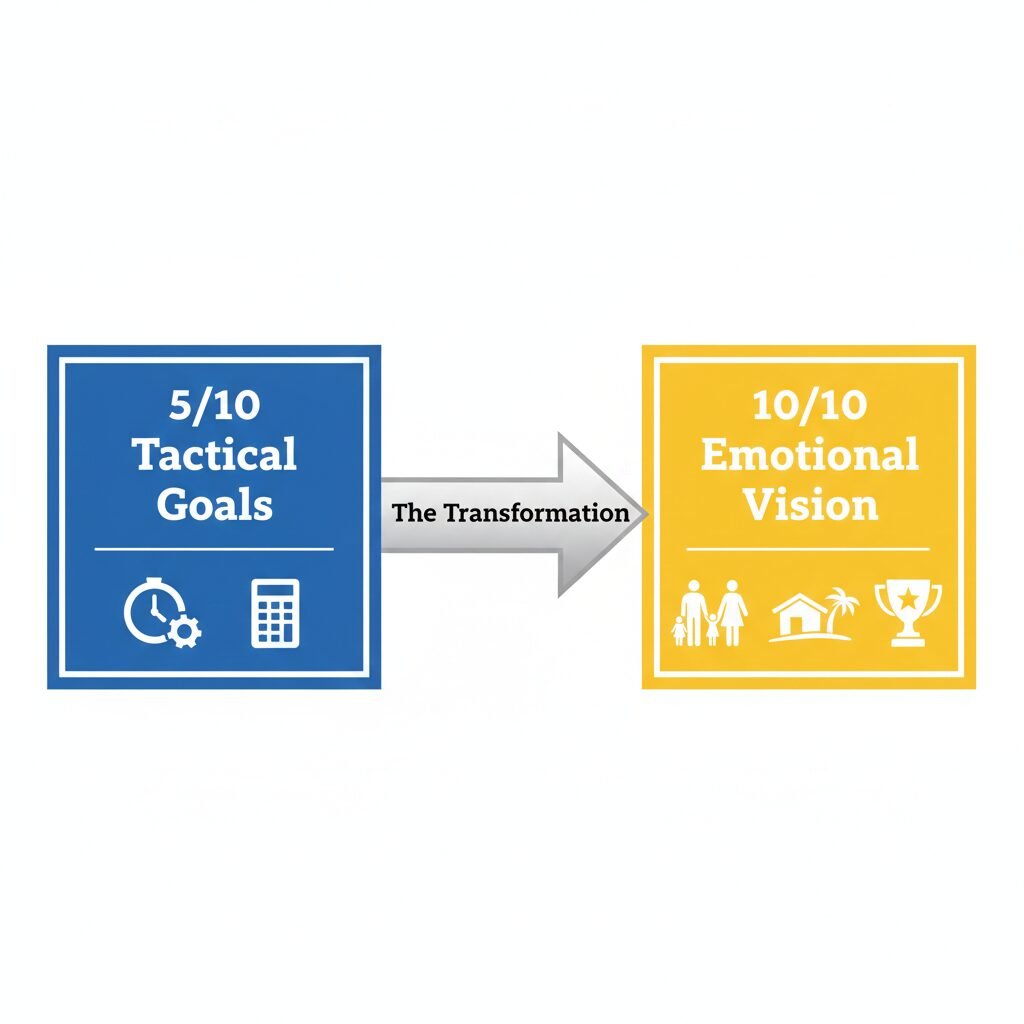
What’s the difference between goals and vision in business? Goals are the tactical targets you set (revenue, profit, client count). Vision is the emotional destination behind those targets – who you become, what your life looks like, why the numbers matter. Most business owners set goals without vision, which is why they never feel excited about achieving them. They’re chasing 5/10 targets instead of 10/10 destinations. This blog shows you how to find the goal behind the goal, test if your current target actually excites you, and build a vision that makes the tactics obvious. If you’ve ever hit a revenue goal and felt empty instead of energized, you’re not alone. The problem isn’t your discipline. It’s that you’re chasing a number you don’t actually care about. Let me show you how to fix that.
🎧 Prefer to Listen? I turned this article into an audio deep-dive perfect for your commute.
Most business owners I talk to can tell me their revenue goal for the year. Ask them to rate how excited they are about that goal on a 1-10 scale, and the room goes quiet.
They pause. They think. Then they say “Seven, maybe?” or “It’s a solid six.”
Never ten.
I’ve conducted over 30 book interviews across industries from landscaping to professional services, from trades to healthcare. I keep seeing the same pattern. Business owners set goals they’ll never get excited about. They’re chasing numbers that feel more like obligations than destinations.
I call this the 5/10 goal trap. You set a target that sounds responsible, realistic, and safe. But here’s the problem: a goal you’re only halfway committed to gets halfway effort. You end up working just as hard, feeling twice as frustrated, because deep down you know you’re settling.
I was talking to a business owner last month who’d hit his $750,000 revenue target. He’d worked 70-hour weeks to get there. When I asked how he felt about the achievement, he went quiet. “It feels like I checked a box,” he finally said. “But nothing changed. I’m still exhausted. I’m still missing my kids’ stuff. The number didn’t matter.”
That’s what happens when you chase goals without vision. You hit the target and feel empty instead of energized.
Here’s what I’ve learned from my research for the second edition of my book on profit strategies: the business owners who actually transform their lives don’t just set better goals. They find the vision behind the goal. They discover what they’re really building and why it matters.
This isn’t about motivation. This is about knowing where you’re actually going so you can build a business that gets you there.

What Is the Difference Between Goals and Vision in Business?
Goals are the tactical targets you set for your business. Revenue numbers, profit margins, client counts, employee headcount. These are measurable, time-bound, specific. They answer the question “What do you want to achieve?”
Vision is the emotional destination behind those targets. It answers “Why does that achievement matter?” and “What does your life look like when you get there?” Vision is about who you become and what becomes possible when the numbers work.
Most business owners set goals without vision. They know they want to hit $500,000 in revenue or increase profit margin by 10%. But they can’t tell you what that actually gives them beyond “more money” or “financial security.” Those aren’t destinations. Those are vague directions.
Think of it like planning a road trip. Goals are the GPS coordinates. Vision is the destination itself. You need both. Just knowing you’re driving to coordinates 42.7325° N, 84.5555° W doesn’t create excitement. But knowing you’re going to that cabin on the lake where your family creates memories every summer? That’s a destination worth driving toward.
Why does my revenue goal feel like a chore?
Because you’re chasing a number without knowing what the number actually gives you. Revenue targets without emotional connection become obligations. You work toward them because you “should,” not because you want to.
When I ask business owners why they set a particular revenue goal, most say “It’s what we need to be successful” or “It’s industry standard growth.” Those aren’t reasons. Those are defaults.
Here’s what the difference looks like in practice:
| 5/10 Goals (Tactics Only) | 10/10 Vision (Emotional Destination) |
| Hit $500K revenue | Build a business my kids are proud of |
| Increase profit margin 10% | Take Fridays off to coach my daughter’s team |
| Hire two more employees | Stop being the bottleneck in my own company |
| Feels like an obligation | Feels like a must-have |
| Rated 5-7 out of 10 for excitement | Rated 10 out of 10 for commitment |
I’ve seen this pattern across every industry I’ve researched. The business owners who are just chasing revenue targets feel stuck. The ones who know their vision behind those targets? They make decisions faster, work with more energy, and actually enjoy the process.
Why a 10/10 Vision Is the Foundation of a Profitable Business
This isn’t just feel-good psychology. Your vision directly impacts your profitability.
When you’re chasing a 5/10 goal, you accept 5/10 clients who drain your energy and negotiate your prices. When you’re pursuing a 10/10 vision, you become selective. You build systems that serve that vision. You price for the life you actually want, not just to be competitive.
This is why I wrote “Profit Foundation.” The foundation isn’t accounting tactics or marketing strategies. The foundation is knowing what you’re actually building and why it matters. Get that clear, and the profit strategies become obvious.
Here’s what I mean. I’m Ryan Herrst with Media Ace Advisors. I work with service business owners across Michigan, particularly in the Greater Lansing and Grand Rapids areas. Over the past year, I’ve interviewed dozens of business owners researching patterns for my book. One pattern shows up everywhere: business owners working incredibly hard to hit goals that don’t actually excite them.
A restoration business owner told me his goal was $1.1 million in revenue. When I asked him to rate his excitement about that goal, he said “Six, maybe seven.” We kept drilling. Turns out his real goal wasn’t the revenue. His real goal was being home in time for dinner four nights a week so he could actually know his kids. The business was never the destination. Being present was the destination.
That shift changes everything. Once you know your real 10/10, you stop accepting every job that comes in. You stop working weekends because “that’s what it takes.” You start building a business that serves the life you want instead of consuming it.
Why Do Most Business Owners Set 5/10 Goals Instead of 10/10?
Business owners set 5/10 goals because they feel “realistic” and “safe.” A 5/10 goal won’t devastate you if you miss it. You can shrug it off. No big deal. Try again next year.
But here’s the trap: a 5/10 goal also won’t energize you enough to actually achieve it. You end up in the worst of both worlds. You’re exhausted from chasing a target you don’t really care about.
There’s actual psychology behind this. Researchers call it “defensive pessimism.” We set lower expectations to protect ourselves from disappointment. In personal life, that might be wisdom. In business, it backfires. A goal you’re only halfway committed to gets halfway effort.
I’ve noticed this pattern in every interview I conduct. Business owners tell me they want to grow revenue or increase profit. I ask them to rate how important that goal is on a 1-10 scale. If they say anything less than 9, I keep drilling. Because the first answer is never the real answer.
One business owner in the Lansing area told me his goal was hitting a certain revenue number. When I asked why that mattered, he said “financial security.” I asked what financial security would give him. “Peace of mind,” he said. I asked what peace of mind would create. Long pause. “The ability to sleep at night without worrying about payroll.”
That’s closer to the truth. But we weren’t there yet. I asked what being free from payroll stress would allow him to do. Another pause. “Actually be present with my wife instead of always thinking about the business.”
Now we’re getting somewhere. His 10/10 wasn’t a revenue number. His 10/10 was feeling connected to his marriage again instead of letting the business consume every conversation.
Once we found that, everything shifted. He could see why the revenue goal felt flat. It was just a means to an end. The real end was reclaiming his marriage from the constant business anxiety.
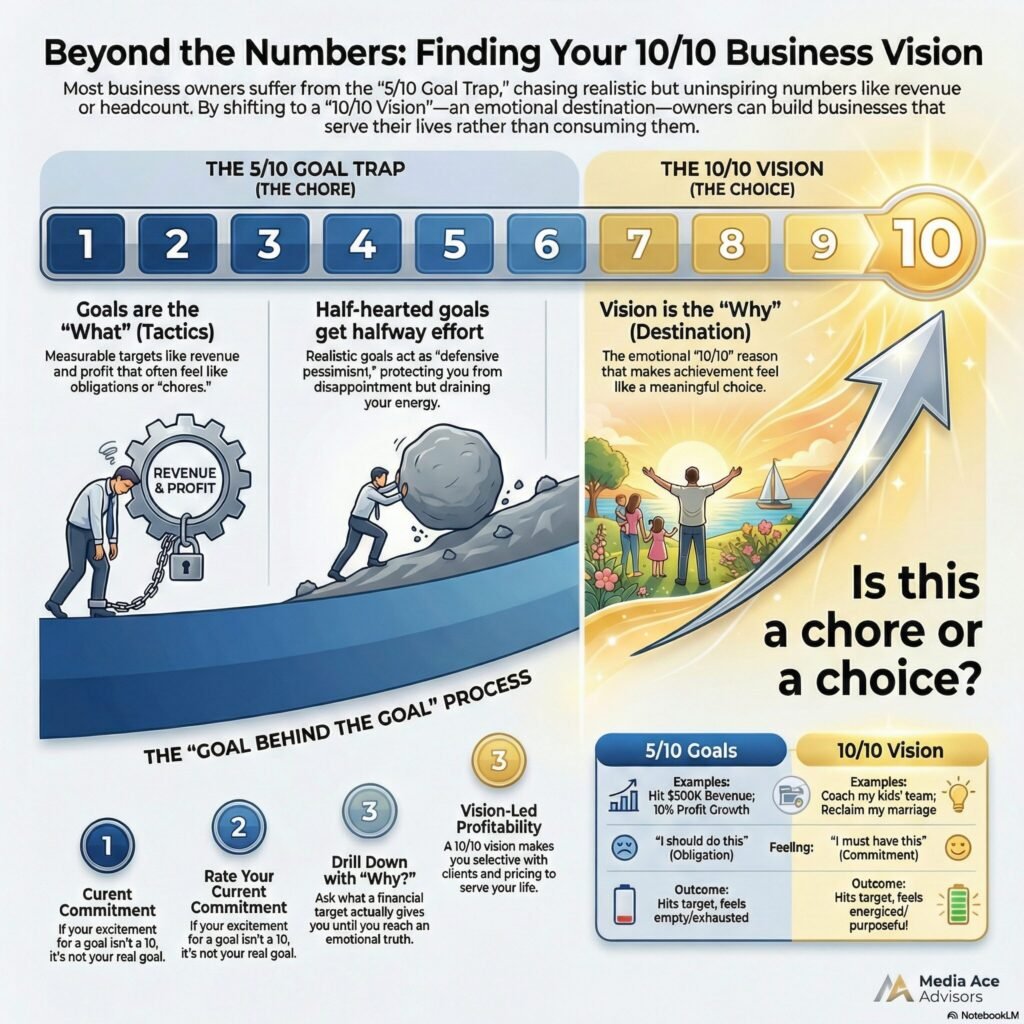
The Goal Behind the Goal: What Do You Really Want?
The drilling process I just described isn’t complicated. But it does require you to be honest about the first answer not being the real answer.
Most business owners stop at the surface. They say “I want to grow revenue” or “I want to hire more people” and never ask why. The why is where the real goal lives.
Here’s how this played out in a recent conversation I had with a business owner. I’m keeping details vague to protect privacy, but the pattern is universal.
Me: “What’s your goal for the business this year?”
Him: “$500,000 in revenue.”
Me: “Great. What does hitting $500,000 give you that you don’t have now?”
Him: “Enough profit to actually pay myself properly.”
Me: “And what does paying yourself properly allow you to do?”
Him: “Stop worrying about money constantly.”
Me: “What would you do with that mental space if you weren’t worrying about money?”
Long pause.
Him: “I’d actually enjoy the work again. I’d remember why I started this thing in the first place.”
Now we’re at the real goal. The $500,000 wasn’t the destination. Rediscovering his love for the work was the destination. The business exists to serve that purpose, not the other way around.
This is what I mean by finding your why. The revenue target is a milestone. But the vision is what makes the milestone worth pursuing.
I’ve seen this across every industry. A landscaping business owner’s 10/10 wasn’t revenue growth. It was being home to coach his son’s baseball team at Patriarche Park in Grand Ledge. A professional services owner’s 10/10 wasn’t client count. It was proving to herself she could build something sustainable after years of corporate burnout. A trade business owner’s 10/10 wasn’t expansion. It was creating jobs for people who needed second chances.
The business goals all looked different. The vision behind them was always deeply personal and emotional.
That’s what you’re looking for. The thing that makes you say “Yes, that’s worth the 70-hour weeks. That’s worth the risk. That’s worth pushing through when it gets hard.”
How Do You Find a Business Goal That Actually Excites You?
Ask yourself this question: “On a scale of 1-10, how committed am I to achieving this goal?”
If the answer isn’t a 10, ask yourself “What would make this a 10?”
The answer to that question is your real goal.
I’ve used this process in dozens of conversations. It works because it forces you to stop lying to yourself about what you actually want.
One business owner told me his goal was succession planning for his family business. I asked him to rate his commitment. He said “Five, maybe.” That’s when I knew succession planning wasn’t his real goal. It was someone else’s expectation.
I asked what would make it a 10. He thought for a long time. “Honestly? Building something I’d actually want to hand down. Right now, I’m just maintaining what my dad built. I don’t want to give my kids a business that requires them to sacrifice their lives like I have. I want to transform this thing so it’s actually worth inheriting.”
That’s a 10. That’s the goal behind the goal. Now we can build a strategy that serves that vision instead of just checking the “succession planning” box.
I’m seeing business owners across Michigan make this shift. They’re moving from “realistic” goals they’ll never get excited about to 10/10 visions that pull them forward. The ones who make this shift aren’t working less hard. They’re working toward something that matters.
Here’s the critical thing: when you find your 10/10, you naturally start making different decisions. You stop accepting clients who don’t serve that vision. You stop implementing strategies that work against your destination. You build systems that move you closer instead of just keeping you busy.
What Happens After You Achieve Your Goal?
This is where most business planning breaks down. Business owners set a goal, achieve it, then… what?
They don’t know. So they just set a bigger number and start grinding again.
I ask business owners this question in every conversation: “Let’s say you hit your goal. Then what?”
Most pause. They haven’t thought that far ahead.
One business owner told me his goal was reaching $1 million in annual revenue. I asked what happens after he hits it. “I guess I’ll go for $2 million?” he said. But he didn’t sound excited. He sounded tired.
I pushed further. “What does your life look like at $2 million that’s different from $1 million?”
Another long pause. “I don’t know. Honestly, I don’t know if I even want $2 million. I think I just said that because it sounds like the next logical step.”
That’s the problem with goals without vision. There’s no natural stopping point. No moment where you say “Yes, this is what I was building toward.” Just an endless treadmill of bigger numbers.
Here’s how this works when you have vision: you set a 90-day goal that serves your one-year vision. Your one-year vision serves your three-year destination. Everything connects.
If your 10/10 is being home for dinner four nights a week, your 90-day milestone might be hiring and training an operations manager who can handle day-to-day issues. Your one-year vision might be removing yourself from daily operations entirely. Your three-year destination might be a business that runs profitably whether you’re there or not.
See how each step builds toward the next? That’s what vision does. It creates a clear path instead of just random targets.
The business owners I work with who get this right aren’t constantly chasing more. They’re building toward something specific. And when they get there, they know it. They can stop, celebrate, and decide what’s next from a place of clarity instead of exhaustion.
The Difference Between Chasing Numbers and Building a Future
Here’s the reality: you can hit every revenue goal you set and still feel empty. I’ve seen it happen. Business owners achieve the numbers they thought would change everything, and nothing changes.
They’re still working 70 hours a week. They’re still missing their kids’ events. They’re still feeling like expensive employees in their own companies instead of actual owners.
That’s what happens when you build a business around goals instead of vision.
But when you find your 10/10 and build toward that? Everything shifts. The tactics become obvious. The decisions get easier. The hard work feels purposeful instead of pointless.
I’ve interviewed business owners who transformed their entire approach just by getting clear on what they actually wanted. Not what they thought they should want. Not what looked impressive to others. What they genuinely wanted for themselves and their families.
The cost of chasing another year of 5/10 goals is high. Another year you’ll never get back. Another year of building someone else’s version of success instead of your own.
The opportunity is right in front of you: find your 10/10 and build a business that serves it.
Want Help Finding Your 10/10?
I’m currently interviewing service business owners for the second edition of my book on profit strategies. During these conversations, I help you drill to your real 10/10 goal. Not what you think you should want. What you actually want.
These aren’t sales calls. They’re strategic conversations where you help me understand what’s actually happening in your industry, and I help you see what you might not be able to see from inside your business.
The process is simple. We spend about 45 minutes talking through your business, your goals, and what you’re really trying to create. I share the patterns I’m seeing across industries. You walk away with mental clarity on your real destination.
There’s no cost. No pitch. Just a conversation between two people who care about building businesses that serve life instead of consuming it.
If you’re a service business owner in Michigan or anywhere else working hard but feeling stuck, let’s talk. Schedule your book interview here: https://advisors.mediaacemarketing.com/contact/
The business owners who win in the next five years won’t be the ones who work hardest. They’ll be the ones who get clear on where they’re actually going and build systems that get them there.
Frequently Asked Questions About Business Goals and Vision
What is the difference between goals and vision in business?
Goals are tactical targets like revenue, profit, and client counts. Vision is the emotional destination behind those targets – who you become, what your life looks like, why the numbers matter. Most business owners set goals without vision, which is why achievement feels hollow.
Can a business survive without a 10-year vision?
Yes, but it won’t thrive. Businesses without vision react to opportunities instead of creating them. You’ll always feel like you’re chasing, never building. A clear vision transforms reactive scrambling into strategic execution.
What if I don’t know what my 10/10 goal is?
Most business owners don’t at first. Start with your current goal, then ask “why does that matter?” five times. The fifth answer is usually your real goal. It’s emotional, not financial. The drilling process helps you get there.
Is it okay to have multiple business goals?
Yes, but they should all serve one emotional destination. If your goals conflict with each other – like grow revenue AND work fewer hours – you haven’t found your real vision yet. The right vision creates goal alignment naturally.
How often should I reassess my business vision?
At minimum, annually. Your vision should evolve as you do. What mattered when you started your business may not matter five years in. The key is making sure your current goals still serve your current vision, not outdated obligations.
About the Author:
Ryan Herrst is a Certified Profit Advisor and author of “Profit Foundation.” He works with service business owners across Michigan, particularly in the Greater Lansing and Grand Rapids areas, to identify hidden profit opportunities. His diagnostic approach combines healthcare systems thinking with business optimization, helping overwhelmed owners transform from expensive employees in their own companies to strategic leaders building sustainable businesses that serve their lives instead of consuming them.
Contact: ryan@mediaaceadvisors.com | 517-955-2154 | www.mediaaceadvisors.com