








You didn’t start your business to become a full-time salesperson. You started it to be the trusted expert in your community, to solve real problems, to build something meaningful.
But somewhere along the way, the business you built turned you into something you never wanted to be: a hunter who has to chase new work every single day just to survive.
Here’s the pattern I’ve observed across hundreds of service businesses. Every month starts the same way. The calendar resets to zero. The pipeline empties.
And no matter how good last month was, you wake up on the first of the month staring at a blank board, feeling the heavy silence of a phone that hasn’t rung since Friday, that stomach-drop sensation of watching a high-performing month vanish into a new month of zeros.
You’re not running a business anymore. You’ve accidentally built a hamster wheel that requires you to run faster every month just to stay in the same place.
The exhausting part isn’t the work itself. It’s the identity crisis that comes with it. You became an expert in your field so you could serve people well, not so you could spend 60% of your time hunting for the next deal.
You wanted to be the business your community trusts and recommends, not another vendor competing on price and hoping the phone rings. But the business model you’re running right now forces you to be a hunter whether you want to be or not.
And hunters never get to rest.
This isn’t about your sales skills or your marketing budget. It’s about a fundamental flaw in how the business is structured. You’re pouring water into a bucket with a hole in the bottom.
Research shows it costs five times more to acquire a new customer than to keep an existing one. But most service businesses spend 90% of their energy chasing new names while the people who already trusted them once drift away and forget they exist.
The revenue model is broken. And the cost of staying stuck in hunter mode is more than just money. It’s your time, your energy, your relationships, and the freedom you thought owning a business would give you.
The +900% Signal: Why Business Owners Are Searching for a Different Way
Something interesting is happening right now in the market. Searches for “how to create loyal customers” have spiked by 900% in the last three months.
That’s not a coincidence. That’s business owners everywhere realizing the old transactional model is breaking down. The hunter approach worked when marketing was cheap and customers had short memories.
But in 2025, with AI-powered search engines and smarter consumers who can spot manipulation from a mile away, the businesses winning aren’t the ones shouting loudest. They’re the ones who earned the right to be remembered.
The businesses that survive and thrive in the next decade won’t be the best hunters. They’ll be the best harvesters. They’ll be the ones who figured out how to stay in the life of their customers so when the need arises again, they’re not just an option.
They’re the only call that gets made.
Here’s what you need to understand. You already have everything required to make this shift. You have a database of people who trusted you enough to hire you once. You have the expertise to solve their problems better than anyone else.
You have a reputation worth protecting. The only thing missing is a systematic way to stay top of mind so those past customers think of you first when they need help again.
You don’t need more leads. You don’t need a bigger marketing budget. You don’t need fancier technology. You need to become a harvester instead of a hunter.
Harvesters don’t chase. They cultivate. They plant seeds through consistent touchpoints that keep them remembered. They create customer relationships that feel less like transactions and more like trusted partnerships.
And over time, they build something hunters can never have: predictable revenue that doesn’t require starting from zero every month. This is the shift from acquisition dependency to frequency optimization. From hoping people remember you to ensuring they can’t forget you.
The businesses that crack this code stop measuring success by how many new customers they get and start measuring it by how many times each customer comes back. They understand that customer lifetime value matters more than short-term wins.
They build systems that drive purchase frequency without feeling pushy or salesy. And the result is monthly recurring revenue that gives them breathing room to actually run the business instead of being owned by it.
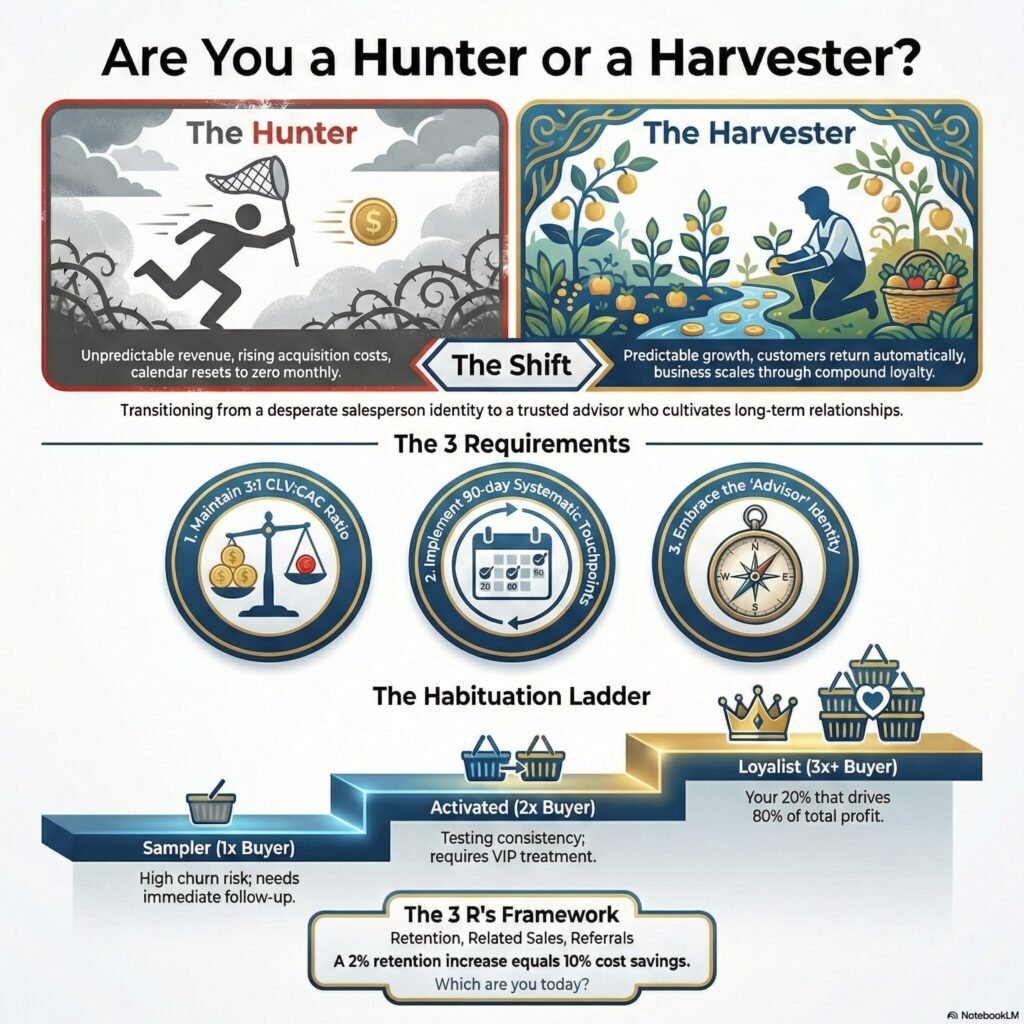
What Are the 3 Non-Negotiable Requirements of a Loyalty-Based Business?
I’ve observed a clear pattern in the businesses that successfully made the shift from hunter to harvester. They all share three non-negotiable requirements.
As you read these, ask yourself honestly whether your business currently meets these standards. If you’re missing even one, your frequency lever isn’t broken. It was never built.
Requirement #1: They Know Their Numbers Cold
Not surface-level awareness. Deep understanding of exactly what drives customer lifetime value in their business. They can tell you their repeat purchase rate without looking it up.
That’s the percentage of customers who come back for a second purchase. They know their purchase frequency, which is how many times the average customer buys from them in a year.
And most importantly, they’ve calculated their customer lifetime value to customer acquisition cost ratio. In simple terms, is the total amount a customer spends with you over their lifetime at least three times what it cost to acquire them in the first place?
If that ratio is below three, you’re spending too much to acquire customers who don’t stick around long enough to be profitable. If it’s above three, you’ve got a foundation to build on.
These businesses don’t guess about these numbers. They track them monthly using a systematic approach like the Pathway to Profit Assessment. They know when the metrics start slipping before it becomes a crisis.
And they make decisions based on data instead of hope. When a harvester looks at their business, they see patterns. When a hunter looks at their business, they see chaos.
Requirement #2: They Have Systematic Touchpoints in Place
Not hoping customers remember them. Not relying on referrals to magically happen. They’ve built a deliberate system for staying in their customers’ lives without being annoying or pushy.
This could be a monthly email that actually provides value instead of just asking for the sale. It could be a quarterly check-in call that shows you care about them beyond the transaction. It could be a customer appreciation event that keeps your brand top of mind.
The specific tactic matters less than the systematic nature of it. Harvesters don’t wing it. They build repeatable processes that ensure no customer ever goes dark and forgets they exist.
I’ve observed businesses that set calendar reminders to reach out to past customers every 90 days with something useful. A seasonal maintenance tip. A relevant industry update.
A simple “thinking of you” message that reminds the customer they matter. These touchpoints don’t sell anything directly. They cultivate the relationship.
They keep you present in their mind so when the need arises, you’re already there. This is the difference between reactive (waiting for them to remember you) and proactive (making sure they can’t forget you).
Requirement #3: They’ve Made the Identity Shift from Hunter to Harvester
This is the hardest one to meet because it’s not tactical. It’s psychological. They stopped seeing themselves as salespeople who have to convince and persuade and started seeing themselves as trusted advisors who customers seek out.
This shift changes everything about how they show up. Hunters are desperate. Harvesters are confident. Hunters chase. Harvesters attract.
Hunters discount to close the deal. Harvesters hold their value because they know what they’re worth.
When you operate from a harvester identity, customer follow up doesn’t feel uncomfortable anymore. You’re not bothering people. You’re staying connected to relationships that matter.
When you send that email or make that call, you’re not hoping they need you right now. You’re planting seeds for the future. And over time, those seeds turn into a garden that produces consistent, predictable revenue without you having to hunt for every meal.
If your business doesn’t meet all three of these requirements, you’re still operating in hunter mode whether you realize it or not. You can’t skip steps. You can’t fake the identity shift. You can’t build loyalty on hope.
But here’s the good news. Every single one of these requirements can be built. The question is whether you’re ready to commit to building them.
The Habituation System: Moving Customers Up the Loyalty Ladder
The businesses that master frequency don’t treat all customers the same. They understand that people exist in different stages of the relationship, and each stage requires a different approach.
This is what I call the Habituation System, and it’s based on a simple insight. Getting someone to buy once is hard. Getting them to buy twice is easier.
Getting them to buy three times turns them into a habit. And once they’re a habit, they become your most valuable asset.
Let me break down the three stages and what each one needs from you.
Stage One: The Sampler
This is someone who hired you once but hasn’t come back yet. They took a chance on you. They had a need, they chose you over the competition, and they got a result.
But they haven’t decided yet if you’re their go-to solution or just someone who was convenient at the time. This is the most vulnerable stage because they can easily drift away and forget you exist.
Your job with Samplers is simple. Make the second purchase feel like the obvious next step. This could be a follow-up offer that solves the natural next problem.
It could be a check-in that shows you care about the outcome beyond getting paid. It could be a “welcome to the family” sequence that starts building the relationship instead of ending it after the transaction.
The Sampler stage is where most businesses lose the game. They celebrate the win, collect the payment, and move on to the next hunt. Harvesters know this is where the real work begins.
Stage Two: The Activated Customer
This is someone who’s purchased from you twice. They came back. They chose you again when they had other options.
This is proof they see value in what you do. But they’re not locked in yet. They’re testing whether you’re consistent or whether the first experience was a fluke.
Your job with Activated customers is to prove consistency and invite them into a deeper relationship. This is where you offer the VIP treatment. The exclusive access.
The thing that makes them feel like they’re part of something special instead of just another transaction. Activated customers are on the fence between loyalty and indifference.
Tip them toward loyalty by showing them what being a valued customer looks like in your world.
Stage Three: The Loyalist
This is someone who’s purchased from you three or more times. They’re not shopping you anymore. They’re not comparing.
They’ve made the decision that you’re their trusted solution for this type of problem. And here’s the remarkable thing. Research shows that 20% of your customers in this Loyalist stage often drive 80% of your profit.
They spend more per transaction. They refer others without being asked. They’re patient when things go wrong because they trust you to make it right.
They’re the foundation of predictable revenue. Your job with Loyalists is to keep them engaged and turn them into advocates.
These are the people who should be getting your best treatment, your first access to new offerings, and your deepest appreciation. They’re not just customers anymore. They’re partners in your business’s success.
The mistake most businesses make is treating everyone the same. Sending the same emails. Making the same offers.
Hoping everyone magically turns into a repeat customer. Harvesters segment by behavior and tailor the approach to where people are on the journey.
If you don’t know which customers are Samplers, which are Activated, and which are Loyalists, you’re flying blind. Start tracking purchase frequency today using a system like your CRM platform.
Sort your customer list by how many times they’ve bought. Then build specific touchpoint systems for each stage. That’s how you move people up the loyalty ladder instead of watching them drift away.
Why Caring Means Challenging (Not Accommodating)
There’s a hard truth I need to share with you, and it might make you uncomfortable. If you’re not willing to challenge your customers, you don’t actually care about their success.
You just want their money.
Real caring looks like this. When a customer says they don’t have time to maintain their equipment, a hunter says “okay, no problem, call me when it breaks.”
A harvester says “that’s exactly why we offer a maintenance agreement. Because I know if you don’t maintain this, you’re going to face a much bigger problem six months from now.”
The harvester isn’t being pushy. They’re being honest. They’re standing for the customer’s long-term success even when it’s uncomfortable in the moment.
I’ve observed this pattern in healthcare services, where a provider might recommend ongoing wellness visits but the patient wants to wait until something hurts. The hunter says “okay, see you when you’re in pain.”
The harvester says “I understand the hesitation, but preventive care now means you avoid the crisis later. That’s why we structure our care plans the way we do.”
This is one of the most misunderstood aspects of how to create loyal customers. Business owners think loyalty comes from being accommodating. From saying yes to everything. From never rocking the boat.
But that’s not loyalty. That’s transaction. Loyalty comes from proving you care more about their outcome than you do about keeping things comfortable.
I’ve observed this pattern repeatedly. The businesses with the most loyal customers are the ones willing to have tough conversations. They’re willing to tell a customer “no, that’s not the right solution for your situation, and here’s why.”
They’re willing to challenge assumptions. They’re willing to stand firm on what they know works instead of caving to what feels easier in the moment.
And customers respect that. They might push back initially, but deep down they know you’re looking out for them instead of just telling them what they want to hear.
This is where the hunter and harvester mindset shows up most clearly. Hunters accommodate because they’re afraid of losing the sale. Harvesters challenge because they’re committed to the relationship.
If your father was making a decision that would hurt him long-term, would you accommodate his choice or would you challenge him? Of course you’d challenge him. Because you care.
The same principle applies in business. Stop accommodating your customers into mediocre outcomes. Start challenging them into excellence.
That’s how you build customer relationships that last decades instead of transactions that end when the check clears.
The Choice Between Two Futures
You have a decision to make, and it’s not about marketing tactics or customer service strategies. It’s about identity.
You can stay a hunter, or you can become a harvester. You can keep waking up every month to zero and hoping the ads work and the leads come and the phone rings.
Or you can build a business where your past customers become your future revenue.
Staying a hunter means working harder every year. Acquisition costs keep rising. Competition keeps increasing.
Customers keep getting smarter about tuning out marketing noise. You’ll spend more money to get fewer results. You’ll work longer hours to maintain the same revenue.
And you’ll never have the freedom you thought owning a business would give you because the business will own you instead. Every time you stop running, the revenue stops flowing.
There’s no compound effect. There’s no momentum. There’s just the exhausting reality of having to hunt every single day.
Becoming a harvester means making a different choice. It means deciding that the next chapter of your business will be built on relationships instead of transactions. On frequency instead of acquisition.
On being remembered instead of being forgotten. It means investing time into building the systems that keep you top of mind. It means tracking the metrics that matter.
It means shifting your identity from salesperson to trusted advisor. And yes, it means having uncomfortable conversations and challenging customers when they need it instead of just accommodating them into mediocrity.
The +900% spike in searches for customer loyalty strategies tells me business owners everywhere are waking up to the fact that the hunting model is broken. Your competitors are looking for this answer right now.
They’re trying to figure out how to create loyal customers who stick around instead of one-time transactions that disappear. The question isn’t whether this shift is happening.
The question is whether you’re going to be one of the businesses that makes the shift or one of the businesses that gets left behind still hunting while everyone else is harvesting.
What Are the 3 R’s of Customer Loyalty?
The most successful harvesters I’ve observed all implement what I call The 3 R’s Framework. This is the operational backbone of a loyalty-based business.
The 3 R’s are: Retention, Related Sales, and Referrals.
First, Retention means stopping churn before it happens. Research shows that a 2% increase in customer retention has the same financial impact as cutting your operational costs by 10%.
Think about that. You could grind yourself into the ground trying to squeeze efficiency out of every corner of your operation. Or you could build a simple system that keeps 2% more customers coming back.
Same result. Completely different path. One requires you to work harder. The other requires you to work smarter.
Second, Related Sales means offering cross-sells and upsells that genuinely solve the next problem your customer faces. This isn’t pushy selling. It’s anticipating their needs and being there with the solution before they have to go looking for it somewhere else.
When you understand your customer’s journey, you know what they’ll need next. Harvesters build systematic offers that guide customers through that journey instead of making them figure it out alone.
Third, Referrals mean turning your Loyalists into an unpaid sales force. When someone has purchased from you three or more times, they’re not recommending you for a discount or a reward. They’re recommending you because they genuinely believe you’re the right solution.
Your job is to make it easy for them to share that belief. Ask for the referral. Create a simple system that reminds them who else might need your help. Make introduction easy and natural.
The 3 R’s Framework works because it addresses all three dimensions of loyalty: keeping the customers you have, deepening the relationship with value, and expanding your reach through trust.
Your Invitation to a Strategic Conversation
I’m currently interviewing service business owners for the second edition of my book, Profit Foundation. These aren’t sales calls.
They’re strategic conversations where I walk you through the same frequency diagnostic I use with coaching clients. You’ll see exactly where your business sits on the hunter-to-harvester spectrum.
I’ll show you which of the three requirements you’re missing and what it’s costing you. And I’ll map out the specific lever that would create the biggest shift in your situation.
Here’s what I’m looking for. I only want to talk to business owners who are all in on making this transformation. If you’re just curious or looking for quick wins or hoping I’ll give you a magic tactic you can implement by next week, this probably isn’t for you.
But if you’re done being a hamster on a wheel and ready to build something that actually serves you instead of owning you, let’s have a conversation.
Fair warning. I’m going to challenge you during this conversation. I’m going to ask you hard questions about whether you’re really ready to make this shift or whether you’re just tired of hunting but not willing to do what it takes to become a harvester.
I’m going to point out the places where you’re accommodating yourself into staying stuck. And I’m going to hold you accountable to what you say you want.
That’s what caring looks like. Not making you comfortable. Making you better.
If you’re ready for that kind of conversation, schedule a time here.
On a scale of 1 to 10, where 1 is “yeah, it would be nice to stop hunting” and 10 is “I can’t go another month like this and I’m all in on building a harvester business,” where are you?
If you’re not a 10, that’s okay. But this conversation is for people who are 10. Because those are the only business owners who actually make the shift.
The 8s and 9s keep hunting for a few more years until the pain gets bad enough. The 10s decide today and never look back.
Your community needs a trusted leader they can rely on. Not another hunter competing on price and hoping to be picked.
The question is whether you’re ready to step into that role. The business you build in the next 12 months will either trap you deeper in hunter mode or set you free as a harvester.
Choose wisely.
About the Author:
I’mRyan Herrst with Media Ace Advisors. I help service business owners earning $250K to $3M annually discover hidden profit opportunities without spending more on marketing.
My approach focuses on the seven profit levers that actually move the needle, with special focus on frequency optimization and building customer relationships that drive predictable revenue. As a Certified Profit Advisor and author of Profit Foundation, I’ve observed the patterns that separate businesses stuck in hunter mode from those thriving as harvesters. If you’re ready to make the shift, let’s talk.
3 Responses