








🎧 Prefer to Listen? I turned this article into an audio deep-dive perfect for your commute.
Key Takeaways: Family business succession planning isn’t about legal documents or ownership transfer. The real profit killers are inherited systems, untouchable employees, and outdated processes that nobody has permission to fix. Here’s how to diagnose what’s actually costing you money, have the hard conversations without starting a war, and modernize without dishonoring the legacy.
The Inheritance Nobody Warns You About
You’re sitting at a desk that used to be your father’s. The filing cabinet in the corner hasn’t been reorganized since before the iPhone existed. There’s an AOL email address still on the side of the work truck. The pricing sheet taped to the breakroom wall hasn’t been updated since Obama’s first term. Your father’s vendor, the one who overcharges by 30%, still gets every order because “he helped us when we were starting out.” And somewhere in the back office, there’s a 19-page physical ledger because Dad doesn’t trust the cloud.
You didn’t just inherit a business. You inherited every decision your parents made for 25 years, including the ones that stopped making sense a decade ago. The employee who can’t be fired because “she’s been here since we opened.” The pricing structure that hasn’t changed since gas was $2.50 a gallon. The processes that exist for no reason other than “it’s how we’ve always done it.”
This isn’t nostalgia. This is a profit crisis wearing a family photo frame.
Family businesses make up roughly 90% of all businesses in the United States. They generate more than half of the nation’s GDP. But according to the Conway Center for Family Business, only about 30% of them survive into the second generation, 12% into the third, and just 3% to the fourth. Those numbers aren’t just about bad estate planning or messy legal transfers. They’re about inherited systems that slowly bleed profit until there’s nothing left to pass on.
And here’s the part nobody says out loud. Your parents built this business to provide freedom for the family. If the business is currently a cage for you, you aren’t honoring the legacy. You’re fulfilling their biggest fear. Let that sink in for a moment.
Family business succession planning isn’t about legal paperwork or LLC transfers. It’s about inheriting a profit structure built for a different era and not having permission, from yourself or anyone else, to change it.
The Objective Outsider
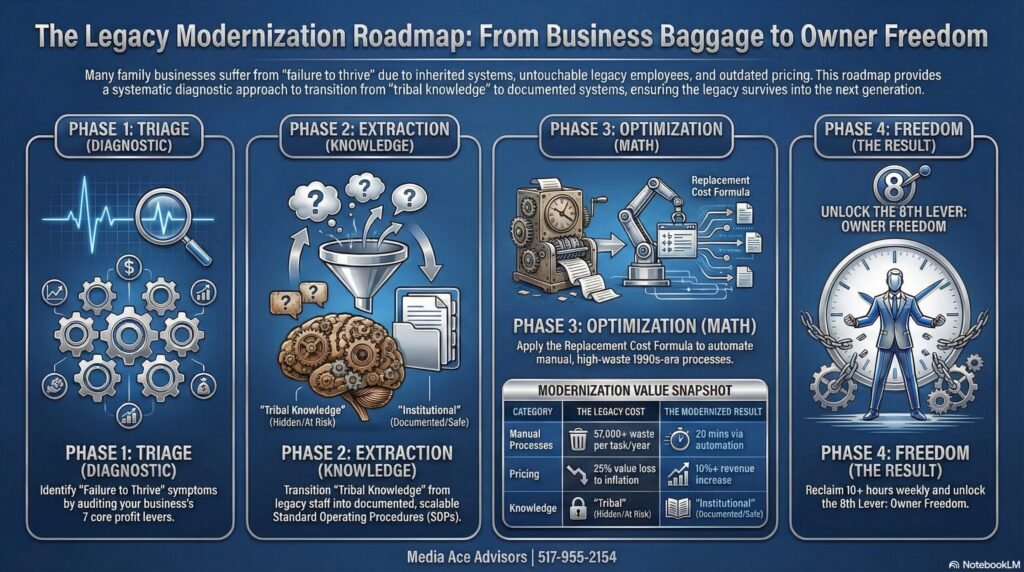
A Diagnostic Note from a Former Nurse: In healthcare, we have a term called “failure to thrive.” The patient looks okay on the surface. Vitals seem stable. But the underlying systems are slowly shutting down. By the time the visible symptoms show up, the damage has been compounding for months or years. In business, your “vitals” are your 7 profit levers. And when those levers are clogged with inherited inefficiency, the business can look fine on the outside while it’s quietly bleeding out on the inside.
That’s exactly what I see in family businesses every week. The revenue looks fine. The customers keep coming. But underneath, the profit structure is riddled with inherited waste that nobody has been authorized to clean out. I’m Ryan Herrst with Media Ace Advisors, a Certified Profit Advisor and author of “Profit Foundation.” My healthcare background trained me to diagnose systematically: look at the vitals, ask structured questions, find root causes, prescribe treatment. I bring that same approach to business.
And here’s the pattern I keep seeing. Second-generation owners are some of the most capable people in business. But they’re fighting with one hand tied behind their back because of “legacy baggage” they didn’t create and don’t feel authorized to fix.
Most advisors tell 2nd generation owners to “grow the business” or “get more customers.” But you can’t outgrow inherited inefficiency. More revenue through a broken system just means more waste at a larger scale. All because you can chase more leads doesn’t mean you should, especially when there’s six figures hiding in the systems you already have. If you’ve ever wondered why more leads don’t actually improve profitability, this is exactly why.
There are three specific places where legacy baggage clogs your profit levers, and I’m going to walk you through each one with real math. Plus, I’ll give you the exact words to use when someone pushes back with “we’ve always done it this way.”
The Legacy Baggage Audit
The Untouchable Employee Problem
Every family business has at least one. The employee who’s been there 20 years, knows where everything is, but operates at 60% of what a modern hire would produce. Nobody questions them because of their tenure. They might even be the person who watched you grow up, which makes this conversation feel impossible.
Here’s a simple framework to evaluate it objectively. Consider two factors: loyalty and productivity.
| High Productivity | Low Productivity | |
| High Loyalty | Keep & Develop (your core team) | Danger Zone (the “untouchable” costing you) |
| Low Loyalty | Flight Risk (invest in retention) | Clear Decision (exit path) |
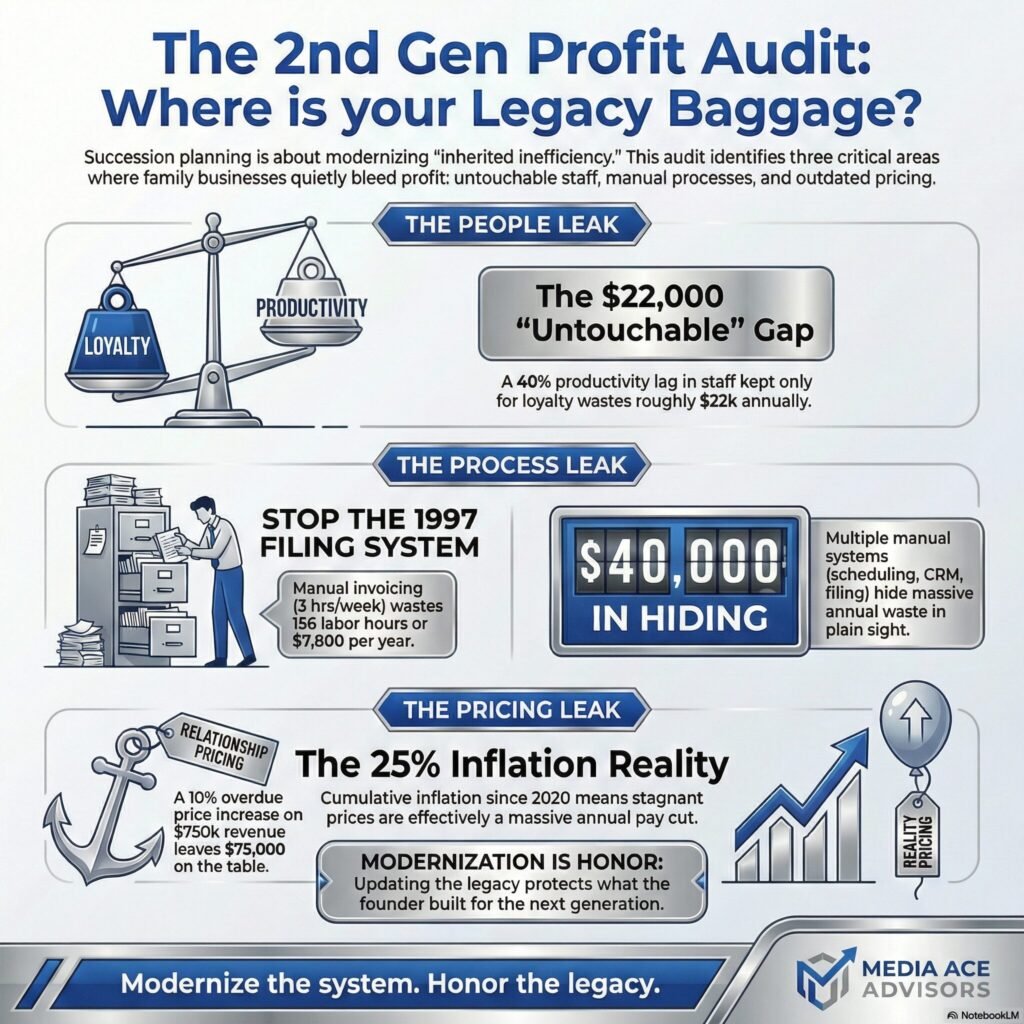
That upper-right quadrant is where most family businesses lose money without realizing it. If someone is producing 60% of what the role requires while earning full compensation, that gap is a direct margin leak. On a $55,000 salary, that 40% productivity gap represents roughly $22,000 in annual waste. Multiply that across two or three “untouchable” positions and you’re looking at a significant hit to your overhead that nobody can see because nobody is willing to look.
You can calculate whether to act using a straightforward formula:
$$(Lost\ Productivity \times Hours) + (SOP\ Creation\ Cost) < (Annual\ Margin\ Leak)$$
If the cost of documenting their processes and training a replacement is less than what the productivity gap costs you each year, the math is clear.
But here’s the thing. The goal isn’t to get rid of your most loyal people. The goal is to make sure their 30 years of knowledge doesn’t walk out the door when they retire next year, or next month, or without warning. Document their wisdom. Build standard operating procedures from their experience. Turn tribal knowledge into institutional knowledge. You’re not replacing them. You’re making sure their contribution to this business lasts longer than their tenure. That’s not disrespect. That’s the highest form of honor. If you want a deeper dive on turning tribal knowledge into documented systems, I’ve written about exactly that process.
The 1997 Filing System
Paper invoicing when digital exists. Manual scheduling when automation is available. A pricing spreadsheet from 2012 that doesn’t account for current material costs. A CRM that’s actually a Rolodex, or worse, the founder’s memory and a stack of business cards held together with a rubber band.
Each outdated system creates compound inefficiency. A manual invoicing process that takes 3 hours per week costs 156 hours per year. At even $50 per hour in loaded labor cost, that’s $7,800 annually on a task that modern software handles in 20 minutes. Multiply that across four or five inherited systems and you’re looking at $25,000 to $40,000 in annual waste hiding in plain sight. And these are the same kinds of hidden costs that creep up in every part of your operation. If you’ve never audited where scope creep is eroding your margins, this is the time.
The reason these systems survive isn’t because they work. It’s because changing them feels like erasing the founder’s fingerprints from the business. But updating the filing system doesn’t erase your father’s legacy. It honors it by making his business strong enough to last another generation. Your dad didn’t build this company so it could be held hostage by a filing cabinet. He built it so it could thrive.
The Pricing Guilt Trip
The founder set prices based on relationships, community reputation, and a different economic reality. You know prices need to increase, but you feel trapped by “what Dad would think” or “what our longtime customers expect.”
Here’s the reality. According to the Bureau of Labor Statistics, cumulative inflation since 2020 alone is roughly 25%. If your prices haven’t increased in five years but your costs have risen that much, you’ve effectively given yourself a pay cut every single year. For a business doing $750,000 in revenue, a 10% price increase that’s three years overdue represents $75,000 in annual revenue you’ve been leaving on the table. Not because you can’t raise prices. Because you feel like you shouldn’t.
Your father charged what was fair for his era. Charging what’s fair for yours isn’t betrayal. It’s continuation. If you want to see exactly where your pricing stands, the 5-Minute Pricing Audit will show you the gap in black and white. And if you want to understand the psychology behind why capable business owners consistently undercharge, this piece on pricing psychology goes deeper.
How to Win the Argument Without Starting a Fight
Now you know where the leaks are. But knowing isn’t the hard part. The hard part is the conversation. According to PwC’s 2023 Family Business Survey, 72% of family business owners want the business to stay in the family, but only 34% have a documented succession plan. The gap between wanting to preserve the legacy and actually having the hard conversations about modernizing it is where most businesses slowly die.
Here are three sentences you can use tomorrow morning when someone says “we’ve always done it this way.”
The Legacy Protector: “I want to make sure what you built lasts another 30 years. Can we look at this one thing together?”
The Customer-First Redirect: “You taught me that the customer always comes first. Right now, this process is slowing us down for the customer. Can I show you what I mean?”
The Honor Frame: “I’m not trying to erase what you built. I’m trying to protect it. This one change would save us $_______ a year, and that means the business is stronger for the next generation too.”
Notice what all three have in common. They honor the founder. They focus on one specific thing, not a wholesale overhaul. And they use “we” instead of “I.” You’re not staging a coup. You’re inviting a partnership.
The 8th Lever Nobody Talks About
Every business has seven profit levers: leads, conversion, transaction size, frequency, margins, retention, and referrals. But for second-generation owners, there’s an invisible 8th lever that matters more than all the others. Owner Freedom.
If you can’t take two weeks off without the business stalling, you don’t own an asset. You’ve inherited a high-stress job that happens to have your family name on the building. According to Cornell’s Smith Family Business Initiative, nearly a third of family business owners have no plans to retire, ever. The average lifespan of a family-owned business is just 24 years. That’s not a legacy. That’s a countdown.
Every legacy system you fix, every process you document, every “untouchable” situation you resolve moves you closer to actually owning a business instead of being owned by one. Your parents didn’t build this so you could be trapped. They built it so you could be free.
The Conversation You Can’t Have Alone
Family business succession planning is really about three things. Having the courage to look at inherited systems objectively. Having a framework to evaluate them without guilt. And having someone outside the family who can say what you can’t say to Dad, or Mom, or Uncle Steve, or the 20-year employee who watched you grow up.
You now have the Loyalty Matrix, the Replacement Cost Formula, and three scripts for the hard conversations. But there’s one thing a blog post can’t give you: an objective set of eyes on your specific situation.
Doing nothing is also a decision. It’s a decision to let the legacy bleed out one inherited system at a time.
I’m currently interviewing service business owners for the second edition of “Profit Foundation.” During these 45-minute research conversations, I walk through the seven profit levers and show you exactly where your inherited systems are leaking money. It’s not a sales pitch. You’ll walk away knowing which legacy baggage items are costing the most and which ones to tackle first.
If you’re a second-generation owner who’s ready to modernize without burning it down, schedule a conversation here.
There’s no cost and no obligation. You’ll get a free copy of the book when it’s published, and I’ll get insights for the research. Most people walk away with two or three specific opportunities they can act on immediately to start generating revenue through their existing systems instead of chasing new customers.
If you took over a family business: what’s the one “old school” system or process you’re afraid to change because of the Old Guard? I promise you’re not the only one.
About the Author: I’m Ryan Herrst with Media Ace Advisors. I’m a Certified Profit Advisor and author of “Profit Foundation.” I help service business owners (annual revenue $250K to $5M, 10 or fewer employees) find hidden profit opportunities without additional marketing spend. My healthcare background gave me a diagnostic mindset: look at the vitals, find the root cause, prescribe the right treatment. I bring that same systematic approach to business profit optimization. Contact me at ryan@mediaaceadvisors.com or call 517-955-2154.