








It’s Sunday night. You’re lying in bed, staring at the ceiling, running through the mental list of everything you know you should be doing but aren’t.
The price increase you’ve been meaning to announce for six months. The follow-up system you sketched out on a napkin but never built. The difficult conversation with that underperforming team member you keep postponing. The marketing strategy sitting in a folder on your desktop, untouched since you created it.
You’ve read the books. You’ve attended the webinars. You’ve taken the notes. You could probably teach a workshop on what a service business owner should be doing to increase profit and reduce stress. The information isn’t the problem. You have more business knowledge in your head right now than your parents had access to in their entire careers.
So why aren’t you doing it?
This is the question that haunts business owners at 11:47 PM when the house is quiet and there’s nothing left to distract them from the truth. The gap isn’t between ignorance and education. The gap is between knowing and doing.
I call this the Accountability Gap, and it’s costing service businesses six figures every single year. Not because owners don’t know better. Because knowing better has never been enough.
The Pattern That Shows Up Everywhere
There’s a pattern that emerges across service businesses, from contractors to consultants to healthcare practices to professional service firms. The owners who break through revenue ceilings and reclaim their time aren’t the ones who learn more. They’re the ones who build accountability into their operating system. They stop relying on motivation and start relying on structure.
Here’s what most people get wrong about accountability: they think it’s about blame. They picture someone looking over their shoulder, catching mistakes, delivering consequences. That version of accountability feels like punishment, and nobody signs up for punishment voluntarily.
For business owners, accountability is something different entirely. It’s the bridge between knowing and doing, between planning and profiting. It’s the structure that turns good intentions into completed actions. It’s not about having someone to blame when things go wrong. It’s about having a system that makes doing the right thing more likely than avoiding it.
The business owners who close the Accountability Gap don’t just add a new tactic to their routine. They see themselves differently. They stop identifying as someone who “knows what they should do” and start identifying as someone who “does what they committed to do.” That identity shift changes everything about how they run their business and live their life.
As a Certified Profit Advisor who’s spent years examining why some service businesses thrive while others stagnate, I’ve found that accountability touches nearly every profit lever, from pricing execution to cost management to client retention. Knowledge of the levers isn’t the bottleneck. Acting on that knowledge is.
My father used to say, “All because you can, doesn’t mean you should.” The flip side is equally true: all because you know, doesn’t mean you will. Knowledge without accountability is just expensive entertainment.
Why Traditional Accountability Fails
Most accountability systems break down for three predictable reasons.
The first is task focus instead of outcome focus. Traditional accountability tracks whether you completed activities. Did you make ten prospecting calls? Did you send five follow-up emails? Did you spend an hour on marketing? The problem is you can check every box on that list and still have the exact same revenue problem next quarter. Busywork accountability creates the illusion of progress while the needle stays stuck. Real accountability tracks outcomes, not activities. Did revenue increase? Did profit margin improve? Did you actually move closer to the life you want?
The second reason is the absence of real stakes. Telling yourself you’ll “try harder” creates zero consequence for inaction. Writing goals in a journal feels productive but changes nothing when you don’t follow through. The Accountability Gap thrives in environments where missing a commitment costs nothing. When the only person you’re letting down is yourself, your brain finds endless justifications. You were tired. Something urgent came up. You’ll definitely do it next week. The excuses multiply because there’s no real price for making them.
The third reason is isolation. Business owners trying to hold themselves accountable are like doctors trying to perform surgery on themselves. You can’t see your own blind spots. You rationalize your own excuses. You negotiate with yourself and somehow always lose. The stories you tell yourself about why you didn’t follow through feel completely reasonable from inside your own head.
This isn’t just a small business problem. Harvard Business Review research found that companies on average deliver only 63% of the financial performance their strategies promise. McKinsey surveys reveal that 74% of executives don’t have faith that their company’s transformative strategies will succeed. The gap between planning and execution costs organizations at every level.
Dr. Timothy Pychyl, a procrastination researcher at Carleton University, describes the phenomenon as “the gap between intention and action,” calling procrastination “the quintessential breakdown of self-control.” The research is clear: knowing what to do and doing what you know are entirely different cognitive processes. One happens in the planning part of your brain. The other requires overcoming resistance, discomfort, and the pull of easier alternatives.
The 3 Signs You Have an Accountability Gap
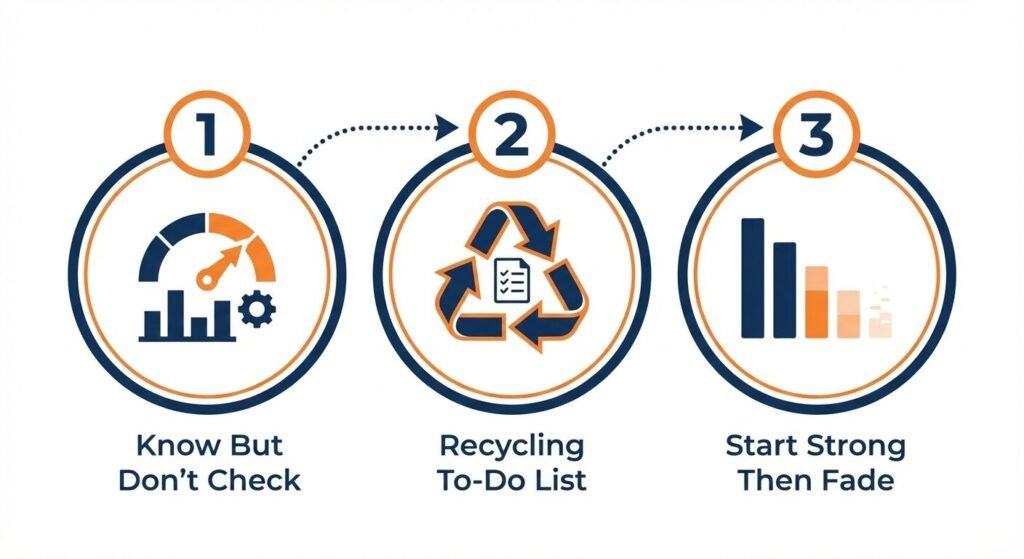
Before you can close the gap, you need to recognize it. Here are three signs that the Accountability Gap is operating in your business.
The first sign is that you know your numbers but don’t check them. You could calculate your profit margin if someone put a gun to your head. You know where to find your conversion rate. You understand which metrics matter for your business. But you don’t actually look at them regularly. The dashboard exists, but you haven’t logged in for weeks. The spreadsheet is there, but you keep meaning to update it. The data that could guide your decisions sits untouched because checking it might reveal something uncomfortable.
The second sign is that your to-do list recycles. The same items appear week after week, month after month. “Update pricing.” “Follow up with past clients.” “Build that onboarding system.” “Have that difficult conversation.” They migrate from one list to the next, never quite urgent enough to complete, never quite unimportant enough to delete. If you looked at your task list from six months ago, how many items would still be there today?
The third sign is that you start strong then fade. New initiatives launch with genuine energy. The first week is great. The second week is decent. By the third week, you’re back to old patterns and the new system is gathering dust. The enthusiasm that felt so powerful at the beginning couldn’t compensate for the missing structure underneath. You’ve started more things than you’ve finished, and each abandoned initiative adds to the weight of evidence that maybe you’re just not the kind of person who follows through.
The Accountability Audit
Answer these five questions honestly.
When was the last time you reviewed your key business metrics with another person? Not glanced at them yourself, but actually walked through them with someone who asked questions and pushed back on your interpretations?
What commitment did you make to yourself last month that you didn’t keep? And what was the consequence? If there wasn’t one, that’s the problem.
Who in your life has permission to ask you uncomfortable questions about your business decisions? Not your spouse who loves you unconditionally. Not your employees who depend on you for their paycheck. Someone with no stake in protecting your feelings.
How many items on your current priority list have been there for more than 30 days? Be honest. Count them.
If someone offered you $10,000 to complete your top three business priorities this week, could you do it? If the answer is yes, then time and knowledge aren’t your problem. Stakes are.
If you answered “I don’t know” or “no one” to more than two of these questions, the Accountability Gap is costing you more than you realize.
The Accountability Bridge: From Knowing to Doing
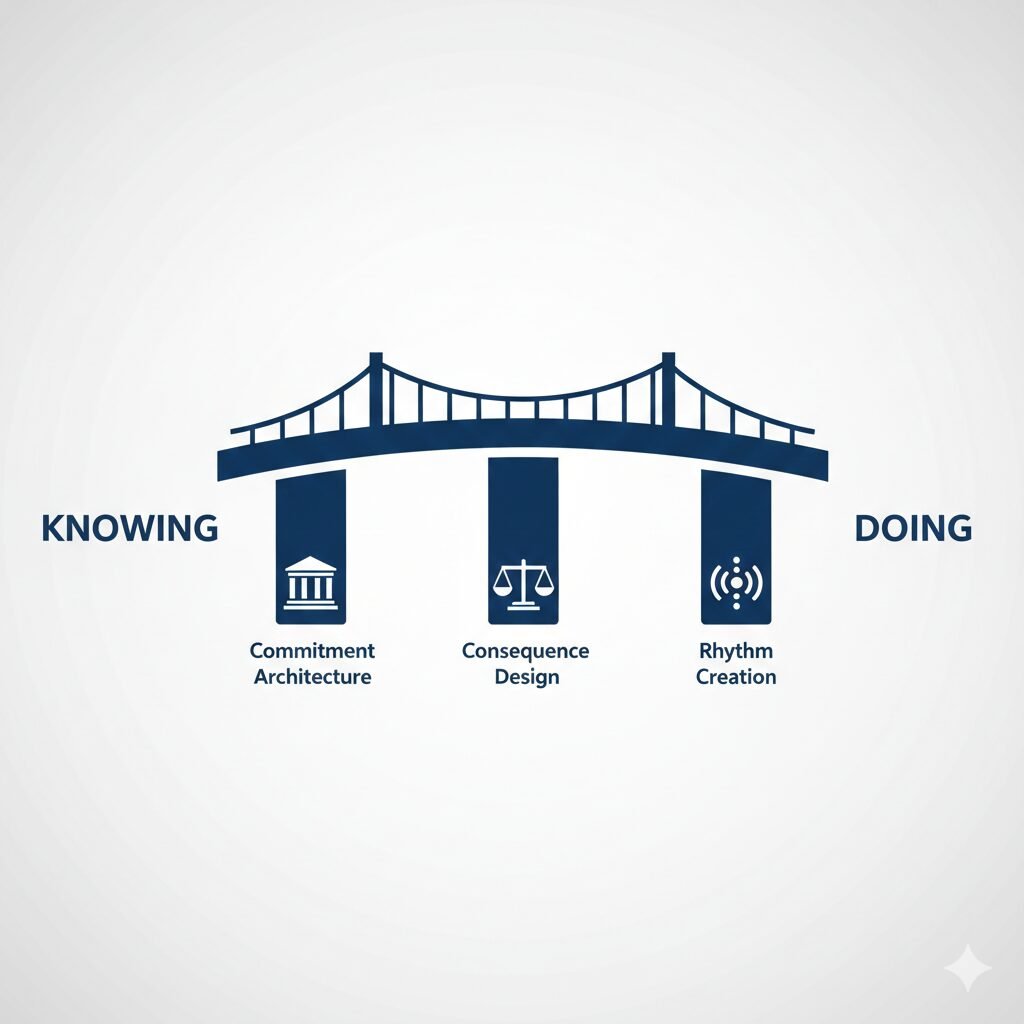
Closing the Accountability Gap requires three components working together.
The first component is Commitment Architecture. This means structuring your commitments so they’re specific, time-bound, and visible to someone other than yourself. “I’ll work on marketing” becomes “I’ll send three past-client reactivation emails by Thursday at noon, and I’ll send you proof when they’re done.” The specificity removes wiggle room. The deadline creates urgency. The visibility creates stakes. Vague intentions allow for vague follow-through. Precise commitments demand precise action.
The second component is Consequence Design. This means building in real consequences for missed commitments. Not punishment for punishment’s sake, but stakes that actually matter to you. This could be financial, like a donation to a cause you oppose. It could be social, like public acknowledgment to your peer group that you missed your commitment. It could be opportunity-based, like losing access to a resource or privilege you value. The consequence has to hurt more than the discomfort of doing the work. Otherwise your brain will always choose avoidance.
The third component is Rhythm Creation. Accountability can’t be a one-time event. It requires consistent rhythm: weekly check-ins, monthly reviews, quarterly recalibrations. The rhythm creates structure. The structure creates execution. Execution closes the gap. Without rhythm, accountability becomes another item on the to-do list that you’ll get to eventually. With rhythm, it becomes the operating system that everything else runs on.
What Closing the Gap Looks Like
During a book interview, a restoration company owner shared a story that perfectly illustrates the Accountability Gap. He’d known for two years that he needed to raise prices. He’d run the numbers multiple times. He’d calculated exactly how much profit he was leaving on the table. He’d drafted the price increase letter. He’d even rehearsed the conversation with himself in the mirror.
Two years of knowing. Zero execution.
When I asked what finally changed, his answer surprised me. It wasn’t a new insight about pricing strategy. It wasn’t a better script for the conversation. It wasn’t finally feeling ready.
It was a commitment he made to his peer advisory group that he would send the price increase letter by Friday. He put $500 in an envelope. If the letter didn’t go out, the money would be donated to a political party he strongly opposed.
The letter went out Thursday.
Within 90 days, his profit margin increased by 18%. Not because he learned something new about pricing. Because he finally did what he’d known to do for 24 months. The knowledge had been there the entire time. The accountability structure is what turned knowledge into action.
When I asked if he felt manipulated by his own system, he laughed. “I felt free,” he said. “For the first time in two years, I wasn’t carrying around the weight of something I knew I should do but wasn’t doing.”
The math tells the story. Two years of delayed action at a conservative estimate of $3,000 per month in lost profit margin equals $72,000. The Accountability Gap has a price tag, and most business owners never calculate it.
When This Framework Won’t Help
I want to be honest about the limitations of this approach.
This framework assumes you actually know what needs to be done. If you’re genuinely unclear on strategy, if you’re not sure which lever to pull or what your numbers even mean, accountability won’t help. You need clarity first. A structure that ensures you follow through is useless if you’re following through on the wrong things.
This also isn’t designed for businesses in true crisis mode. If the issue is survival, if you’re fighting to make payroll or keep the doors open, you need triage before you need accountability systems. The fundamentals of staying alive come before the systems of thriving consistently.
And if you’re pre-revenue or just starting out, the rules are different. Early-stage businesses need experimentation and discovery, not rigid accountability to a plan that hasn’t been validated yet.
The Accountability Gap framework is for established service businesses with proven models who know their next level but can’t seem to reach it. If you’re honest with yourself about which category you fall into, that honesty itself is the first step toward closing the gap.
The Cost of Staying the Same
Every week that passes with the Accountability Gap in place is another week of unrealized profit. Another week of knowing what to do and not doing it. Another week of watching competitors who aren’t smarter than you, just more structured, pull ahead.
Picture two versions of yourself six months from now.
In one version, you’re still carrying the same list of things you know you should do. The pricing conversation you’ve delayed. The system you’ve meant to build. The boundary you’ve needed to set. The weight of unfinished intentions follows you into every weekend, every vacation, every quiet moment. The Sunday night ceiling-staring continues.
In the other version, you’ve closed the gap. The decisions are made. The actions are complete. You’re not lying awake thinking about what you should do because you’ve already done it. The mental weight is gone. The profit is real. The freedom isn’t something you’re working toward anymore. It’s something you’re living.
That’s the difference accountability makes. Not more knowledge. Finally acting on what you already know.
Your Next Step
You didn’t start your business to become someone who talks about what they’re going to do someday. You started it to build something meaningful, to serve your community, to create freedom for yourself and your family. The gap between who you are and who you’re capable of becoming isn’t knowledge. It’s accountability.
I’m currently conducting book interviews with service business owners as research for the next edition of Profit Foundation. These 45-minute conversations help me understand the real challenges owners face, and they give you a chance to step back and examine your business with fresh eyes. Many owners tell me it’s the first time anyone has asked them these questions.
If you’re ready to close your Accountability Gap and finally turn what you know into what you do, I’d welcome the conversation. No pitch. No pressure. Just a chance to get clear on what’s actually standing between you and the profit your business should be generating.
About the Author
Ryan Herrst is a Certified Profit Advisor and author of Profit Foundation. He helps service business owners discover hidden profit opportunities without spending more on marketing. His approach focuses on the seven profit levers that most businesses ignore while chasing more leads. Ryan believes that sustainable business growth comes from strategic subtraction, not endless addition, a philosophy inherited from his father’s wisdom: “All because you can, doesn’t mean you should.”