







Business owner burnout isn’t caused by lack of effort. It’s caused by lack of perspective.
You’re surrounded by people who love you but can’t coach you. Every Olympic gold medalist has a team of data-driven guides who see what the athlete can’t see.
Your business deserves the same strategic support. The question isn’t whether you need a coach. It’s whether you’re ready to hear the truth.
🎧 Prefer to Listen? I turned this article into an audio deep-dive perfect for your commute.
Why Do I Feel Like I’m Failing Even When Revenue Is Up?
Everyone wants something from you.
Your employees want direction. Your customers want service. Your vendors want payment. Your family wants you present. Your phone wants your attention.
You’re the linchpin. If you stop, everything collapses.
You didn’t build a business. You built the most expensive job you’ve ever had.

Here’s what your Tuesday looked like last week. Employee called in sick (you covered their job). Customer complained about timeline (you apologized and discounted). Vendor needed immediate payment (you juggled cash flow). Spouse asked when you’d be home (you lied and said soon). Got home at 8:47 PM (kids already in bed). Checked email one more time (three fires to put out tomorrow).
This isn’t a bad week. This is EVERY week. You’re working harder than you ever did as an employee, making less per hour than you could working for someone else, and you can’t remember the last time you turned your brain off.
The business was supposed to give you freedom. Instead, it demands everything. You started because you were good at what you do and thought you could do it better. Now you’re drowning in what nobody taught you: hiring, firing, pricing, systems, cash flow, marketing, sales.
Your family is becoming cheerleaders from the sidelines instead of people you actually spend time with. Your friends stopped inviting you to things because you always cancel. Your doctor says your blood pressure is concerning. Your spouse is patient, but you see it in their eyes: “When does OUR life start?”
And here’s the worst part. You don’t know who to ask for help.
Five Signs You Have Cheerleaders Instead of Coaches
Take a second and see if any of these sound familiar:
- Everyone tells you “keep going” but nobody asks “where are you going?”
- Your spouse says “do whatever makes you happy” (but working 70 hours doesn’t make anyone happy)
- Your business friends share tactics but never challenge your strategy
- Your employees want direction but you don’t know who to ask for YOUR direction
- You make every major decision alone, then second-guess it for weeks
If you recognized yourself in two or more of those, keep reading.
What Do Olympic Athletes Know That Business Owners Don’t?
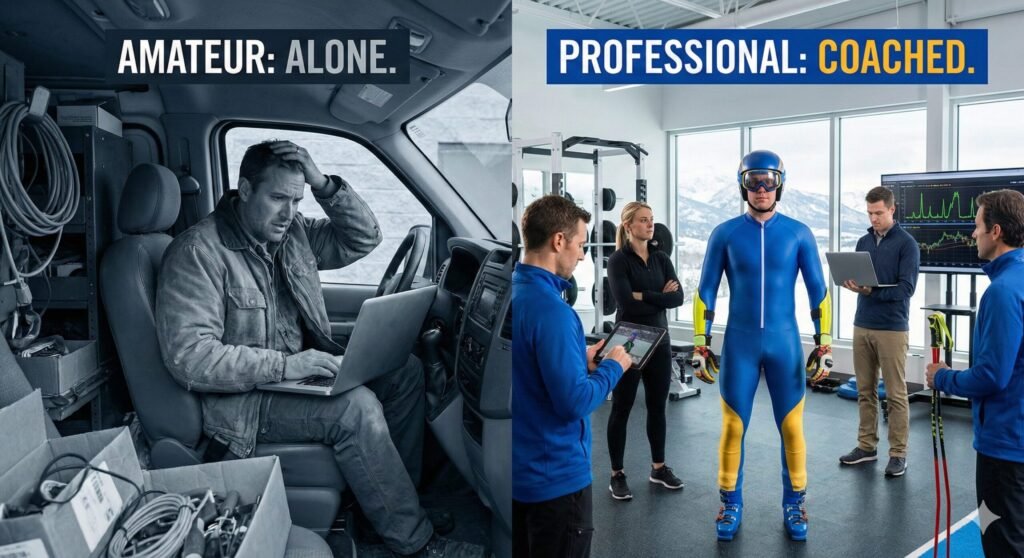
Right now, in Milan and Cortina, Italy, the world’s best athletes are competing for gold medals at the 2026 Winter Olympics. Every single one of them has something you don’t: a team of guides.
Not cheerleaders. Guides.
The alpine skier has a technical coach (for form), a strength coach (for conditioning), a sports psychologist (for mental game), a nutritionist (for fuel), and a physical therapist (for recovery). The figure skater has choreography coaches, jump coaches, and performance coaches.
These athletes don’t question WHETHER they need coaches. They question WHICH coaches to trust.
Meanwhile, here in Grand Ledge, there are service business owners working 60-hour weeks who wouldn’t dream of asking for help. They’ll hire an accountant for taxes and a doctor for health issues, but for the BUSINESS – the thing that funds everything – they’re figuring it out alone on Tuesday afternoons between job sites.
But somehow, you’re trying to run a six-figure or seven-figure business completely alone. The thing that funds your entire life? You’re navigating that without a guide.
Think about it. You probably have:
A doctor when you’re sick. A financial advisor for retirement planning. An accountant for taxes. Maybe a therapist for mental health. Possibly a pastor, priest, or rabbi for spiritual guidance. A personal trainer if you’re serious about fitness. A marriage counselor if things get hard.
You don’t question having guides for your health, your money, your relationships, your faith. But for your BUSINESS – the engine that makes everything else possible – you’re trying to figure it out yourself.
Why Is Family Advice Often Bad for Business Growth?
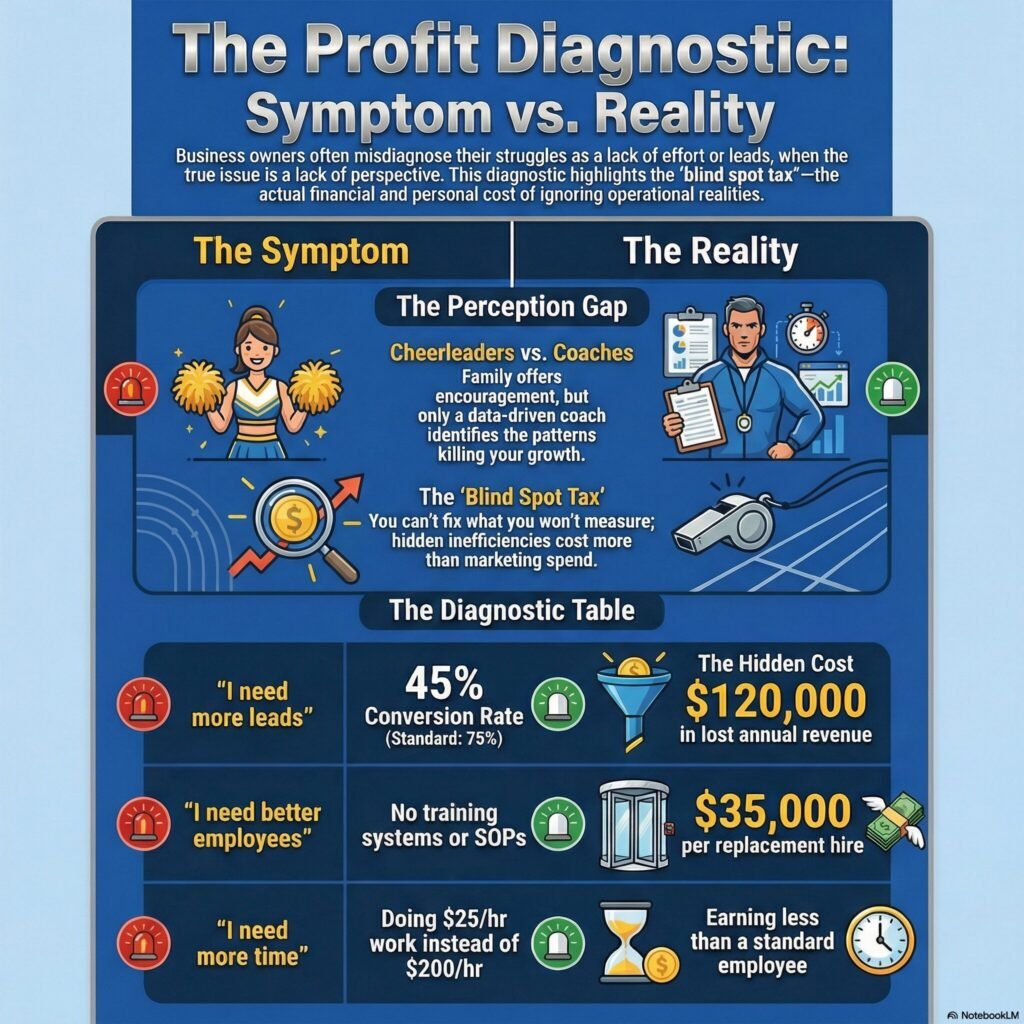
Your family loves you. They want you to be happy. They say “you’re doing great, keep going!” That’s beautiful. That’s necessary. But love makes people terrible diagnosticians.
Your spouse can’t tell you that your pricing is $40,000 too low. Your friends can’t see that you’re attracting the wrong clients. Your parents can’t identify that your business model is the thing keeping you stuck.
They’re cheerleaders. And every athlete needs cheerleaders.
But behind every gold medal is a coach who cares enough to tell the truth you need to hear, not just the encouragement you want.
What Can’t You See When You’re Inside Your Own Business?
The problem isn’t that your family and friends don’t care. The problem is they care TOO MUCH about you and not enough about your GROWTH.
When your spouse says “do whatever makes you happy,” they’re being a great partner. But they can’t see that happiness isn’t found in working 70 hours a week. They don’t know the questions to ask. They don’t want to hurt you. So they encourage you to keep doing what’s clearly not working.
Your business friends? They’re in the same boat you’re in. They can’t see their own blind spots, so they definitely can’t see yours. It’s the drowning person trying to save the drowning person. You’re both going under, just at different speeds.
Your industry peers? They have a vested interest in you NOT succeeding too much. They’ll share surface-level tactics but never the transformational strategies. Competition creates friendship limits.
Here’s what you need: someone who has NO emotional attachment to keeping you comfortable. Someone who cares about your RESULTS more than your feelings. Someone whose job is to ask the questions nobody else is asking.
That’s not a cheerleader. That’s a coach. That’s a guide. That’s an outsider with expertise who can see what you can’t see because you’re inside the jar trying to read the label.
The Symptom vs. Reality Self-Diagnostic
Take 60 seconds right now. Which of these sounds familiar?
| What You Think You Need | What’s Actually Happening | The Hidden Cost |
| “I need more leads” | Your conversion rate is 45% (industry standard: 65-75%) | Leaving $120K in revenue on the table annually |
| “I need to work harder” | You’re the only one who can do valuable work | Business dies if you get sick, no vacation in 2 years |
| “I need lower prices to compete” | You’re attracting price shoppers, not quality buyers | Racing to the bottom while premium competitors thrive |
| “I need better employees” | You have no training system, so everyone wings it | High turnover costs you $35K per replacement hire |
| “I need more time” | You’re doing $25/hour work while $200/hour work goes undone | Your effective hourly rate is less than when you were an employee |
Which row made your stomach drop? That’s your blind spot.
This is what I observe across hundreds of conversations with service business owners earning $250K-$5M annually.
You think you need more leads. What you actually need is to convert more of the leads you already have.
A restoration company owner thought he needed more leads. His marketing was working. Phones were ringing. But he was converting only 43% of estimates to jobs.
The problem wasn’t lead volume. The problem was his follow-up system had a three-hour response gap. In restoration, if you don’t respond in an hour, the customer calls the next company.
We fixed the follow-up timing. Same lead volume. Conversion jumped to 71%. That’s an extra $147,000 in annual revenue from calls he was already getting. His customer acquisition cost (CAC) stayed flat while revenue increased 65%.
You think you need to work harder. What you actually need is to stop being the only person who can do anything valuable.
A chiropractor in the Lansing area was working 60 hours a week, six days, no vacation in two years. She was making good money but missing her daughter’s swim meets. The business was consuming her life.
We didn’t add services. We didn’t expand locations. We built delegation systems and pricing structure.
Now she works 45 hours, four and a half days. Revenue actually increased by $75,000 because she stopped attracting the wrong clients who demanded discounts and constant availability.
You think you need lower prices to compete. What you actually need is to educate prospects on how to evaluate quality so they CHOOSE you at higher prices.
An accounting firm didn’t change their pricing. They changed their consultation process to educate instead of pitch. Conversion went from 42% to 67%.
That’s 15 additional clients per year at $8,000 average value. $120,000 in annual revenue from the same marketing spend. Their variable costs stayed the same while profit margins improved dramatically.
You can’t see these patterns yourself because:
First, you’re too close to your own business. Second, you don’t have comparison data across industries. Third, your ego is attached to certain beliefs (if I want it done right, I have to do it myself). Fourth, you’ve never built a business before, so you don’t know what’s normal versus broken. Fifth, you’re too busy surviving to think strategically about your profit margins, gross margin, or cost of goods sold (COGS).
This isn’t a character flaw. This is a perspective problem. You don’t need to try harder. You need to see differently.
What Makes a Guide Different From a Consultant?
Here’s what I’m NOT.
I’m not the guru who’s already built the eight-figure empire and now teaches from the mountaintop. I’m not the consultant who swoops in, tells you what to do, and disappears.
I’m in the middle of my own journey. I still work 40 hours a week in healthcare while building my coaching practice. I haven’t “arrived.” But here’s what my 25+ years in ICU nursing taught me:
I can diagnose multi-system organ failure even though I’ve never personally had emphysema, vascular disease, and diabetes simultaneously. I watched my father die from smoking-related complications. I couldn’t save him. But I could SEE what was killing him when he couldn’t see it himself.
That’s what I do for businesses. I see the patterns you can’t see from inside. I ask the questions nobody else is asking. I walk alongside you and ask “did you do what you said you’d do?” without needing you to like me.
I’m not the expert with all the answers. I’m the guide with better questions. I can ask the questions that reveal where you’re actually trying to go (not just where you SAY you’re trying to go). I’ve conducted hundreds of these diagnostic conversations. I know the six-layer drilling technique that gets business owners from “I need more revenue” to “I want to prove to myself I’m not a failure.”
I’m one more resource in your ecosystem, just like your doctor, your accountant, and your therapist. All because you CAN do everything yourself doesn’t mean you SHOULD.
What Actually Changes When You Have Outside Perspective?
Here’s what happens when you add external perspective to your business:
You stop making decisions in a vacuum. Instead of agonizing for three weeks about whether to fire that difficult client, you talk it through with someone who’s seen this pattern 47 times before. Decision made in one hour. You realize the client isn’t the problem. Your lack of boundaries is the problem. Scope creep has been killing your profit margins for years.
You see blind spots you didn’t know existed. Like the restoration company owner who thought he needed more leads, but actually he was losing 40% of estimates because his follow-up system was broken. Same lead volume. 40% more revenue. Blind spot fixed. His customer lifetime value (LTV) improved dramatically just by tightening response time.
You build systems instead of heroes. Your business stops depending on you being amazing at everything. You document what works, train others to execute, and extract yourself from daily operations. You move from employee to actual owner. Strategic planning becomes possible when you’re not firefighting every day.
You make proactive decisions instead of reactive ones. For the first time in years, you’re working ON the business instead of just IN it. You’re planning six months out instead of scrambling for next week. You’re thinking about client retention instead of just acquisition.
You get accountability without judgment. Someone who cares enough to call you out when you’re avoiding hard decisions, but respects you enough to let you make your own choices. Partnership, not prescription. You don’t need someone to tell you what to do. You need someone to hold you accountable for doing what you already know needs to happen.
This is what athletes have always understood. You don’t need someone who’s faster than you. You need someone who can see your form when you can’t, who knows the training science, who’s studied hundreds of athletes and can spot patterns.
You need a guide. Not a guru. A guide.
What Does This Look Like in a Mid-Michigan Service Business?
Let me paint a picture of what I observe in Lansing-area service businesses.
The Contractor Who Thought He Needed More Leads:
A contractor in Delta Township thought he needed more leads. But when we looked at his numbers, he was converting only 38% of estimates to jobs.
Industry standard for established contractors is 60-70%. He wasn’t losing jobs because of price. He was losing jobs because his proposals looked like invoices. No education. No differentiation. Just line items and a total.
We rebuilt his proposal process to educate prospects on quality differences. We added a “What to Watch Out For” section that positioned him as the expert. We created a follow-up sequence instead of “submit and pray.”
Conversion jumped to 64% within 90 days. Same marketing. Same lead volume. $186,000 more annual revenue. His fixed costs (overhead, rent, insurance) stayed the same. Pure profit improvement.
The Service Provider Who Was Undercharging:
A professional service provider in East Lansing was working 55 hours weekly and barely breaking even. Revenue was fine. Profit margins were terrible.
When we ran the numbers, she was undercharging by about $40,000 annually. But she was terrified to raise prices because she thought clients would leave.
We didn’t just raise prices overnight. We repositioned her services, improved the delivery experience, and implemented a price increase strategy with existing clients.
She lost two price-sensitive clients (who were marginally profitable anyway). She kept 94% of her client base at new rates. Profit margins went from 12% to 28%. Same work. Better margins. Understanding her fixed versus variable costs made pricing decisions crystal clear.
The Restoration Business With Chronic Turnover:
A restoration business serving the greater Lansing area had chronic employee turnover. Every 8 months, they’d lose someone and spend $35,000+ replacing them (recruiting, training, lost productivity, quality issues).
The owner blamed the job market. “Nobody wants to work anymore.”
But when we looked deeper, they had no training system. New hires were thrown into jobs with minimal guidance. They’d make mistakes. Customers would complain. The owner would get frustrated and fire them.
The problem wasn’t the job market. The problem was lack of standard operating procedures.
We documented the top 10 recurring processes. Built a 2-week training program. Created quality checklists.
Turnover dropped from 8 months to 24 months average tenure. Customer complaints decreased by 60%. The owner got his evenings back because he wasn’t constantly fixing mistakes. Employee-related variable costs (turnover, rework, customer service) dropped significantly.
These aren’t unicorns. These are observable patterns across service businesses. The owners aren’t lazy. They’re not stupid. They’re just too close to see what’s broken.

How Do I Know If I Need a Business Coach or If I Can Fix This Myself?
Here’s the honest truth.
You probably don’t need a coach if:
You’re working 30-40 hours weekly and profit margins are strong (25%+ for service businesses). You took at least 3 weeks vacation last year. Your business runs smoothly when you’re gone. You’re excited about where you’re building, not just surviving where you are. You have clear systems for everything important. Your business decisions are strategic, not reactive.
You probably DO need a coach if:
You’re working 60+ hours but can’t figure out where the money’s going. You haven’t taken real vacation in over a year (or if you did, you worked from the beach). Everything important requires you personally. You’re making decisions alone and second-guessing them for weeks. Your family is patient but you see it in their eyes: “when does OUR life start?” You know WHAT to do but you’re not doing it. You’re fighting fires instead of building systems.
If you recognized yourself in that second list, here’s what happens next.
Key Takeaways: What To Do Tomorrow Morning
Before you schedule anything, do these three things:
1. Run The Symptom vs. Reality Check: Go back to that table. Which row made your stomach drop? Write down the specific number. Don’t guess. Look at your actual conversion rate, your actual hourly output, your actual employee tenure. You can’t fix what you won’t measure.
2. Identify Your Blind Spot Tax: Calculate what that blind spot is costing you annually. If your conversion rate is 45% instead of 65%, and you get 100 leads annually at $3,000 average job size, that’s $60,000 in lost revenue. That’s your blind spot tax. Write it down.
3. Ask The Question Nobody’s Asking: “What would have to change for me to work 40 hours weekly and make more than I do now?” Don’t answer it yet. Just sit with the question. The answer isn’t more hustle. It’s better strategy. It’s external perspective. It’s a guide who can see what you can’t.
Then, if you’re ready to stop paying the blind spot tax, schedule the conversation.
Schedule Your Free Book Interview
I’m writing a second edition of my book “Profit Foundation,” and I’m conducting research conversations with service business owners earning $250K-$5M annually with 10 or fewer employees. These aren’t sales calls. They’re 45-minute industry research conversations where I learn about your specific challenges, and you get an outside perspective on your business.
Most people who do these book interviews tell me it’s the first time in months (sometimes years) someone asked them what they’re actually trying to build instead of just what they need to fix today.
Some book interviews lead to working together. Some don’t. Either way, you walk away with clarity on whether you’re fighting the right battle or just fighting harder in the wrong war.
If you’re tired of being the most expensive employee in your own company, and you’re ready to hear truth instead of just encouragement, let’s talk.
Fair Warning
I’m going to ask questions that might be uncomfortable. I’m going to challenge assumptions you’ve held for years. I’m going to tell you the truth even if it’s not what you want to hear.
But if you’re done surrounding yourself with cheerleaders and you’re ready for a coach, that’s exactly what you need.
The athletes in Milan and Cortina know something you’re still learning: nobody wins gold medals alone. Behind every victory is a team of guides who saw what the athlete couldn’t see.
Your business deserves the same level of strategic support you’d give an Olympic athlete.
Schedule Your Free Book Interview →
About the Author:
Ryan Herrst is a Certified Profit Advisor and published author of “Profit Foundation.” With 25+ years in healthcare (ICU and OR nursing since 1999) and extensive experience in business optimization, Ryan helps service business owners earning $250K-$5M annually identify hidden profit opportunities without spending more on marketing. Based in Grand Ledge, Michigan, Ryan combines diagnostic thinking from his medical background with systematic business analysis to help owners build businesses that serve their lives instead of consuming them.