







You are probably the best at what you do in your entire company. That used to be enough. Somewhere along the way, the business started needing something you were never trained to give it. You know how to do the work. But running the business that delivers the work is a completely different job. All because you can handle every part of your business doesn’t mean you should.
🎧 Prefer to Listen? I turned this article into an audio deep-dive perfect for your commute.
You Built Something That Works. But It Only Works When You’re There.
Direct answer: A fractional COO is a senior operations leader who works inside your business part-time to fix systems, improve profit margins, and build the kind of structure that lets the owner stop being the bottleneck. For service businesses earning $500K to $5M, this role often finds $50,000 to $150,000 in hidden profit without spending another dollar on marketing.
Here is what nobody told you when you started your business. Every marketing consultant you hired focused on one thing. Every internet marketing service you paid for did the same thing. Every business development service you brought in had the same goal. Put more money in the front door. And most of the time, it worked. More calls came in. More jobs got booked. More people showed up. But nobody ever stopped to ask what was happening to the money once it got inside. You followed that advice in good faith. It was not bad advice. It just skipped the most important step.
That missing step shows up in places you can feel but can’t always name. A full schedule for the next three weeks and a checking account that doesn’t match it. A crew that stays busy every single day while the owner still can’t take a week off without something falling apart. Revenue that climbed 25% last year while the owner’s actual paycheck barely moved. Those gaps are not signs that you need to work harder. They are signs that the business itself needs a different kind of help than what you have been giving it. If that pattern feels familiar, the post on why more leads won’t fix low profit margins is worth reading alongside this one.
What if the next person you bring into your business is not another technician or another agency? What if it is someone whose only job is to make the business run as well as you run the work?
What Is a Fractional COO (And Why Service Businesses Under $5M Are Hiring Them)?
A fractional COO is not a consultant who hands you a binder and disappears. They are a senior operations leader who works inside your business on a part-time basis. Most work somewhere between 10 and 20 hours per month. They bring the same kind of leadership that bigger companies pay $200,000 a year to get full-time, but at a fraction of the cost and commitment.
This model has taken off in the last two years for a simple reason. Service business owners are figuring out that the gap between where they are and where they want to be is not a marketing gap. It is an operations gap. The phones ring. The jobs come in. But the money doesn’t stay. To understand how this role compares to other types of outside help, the post on what a business management consultant actually does breaks down the full picture.
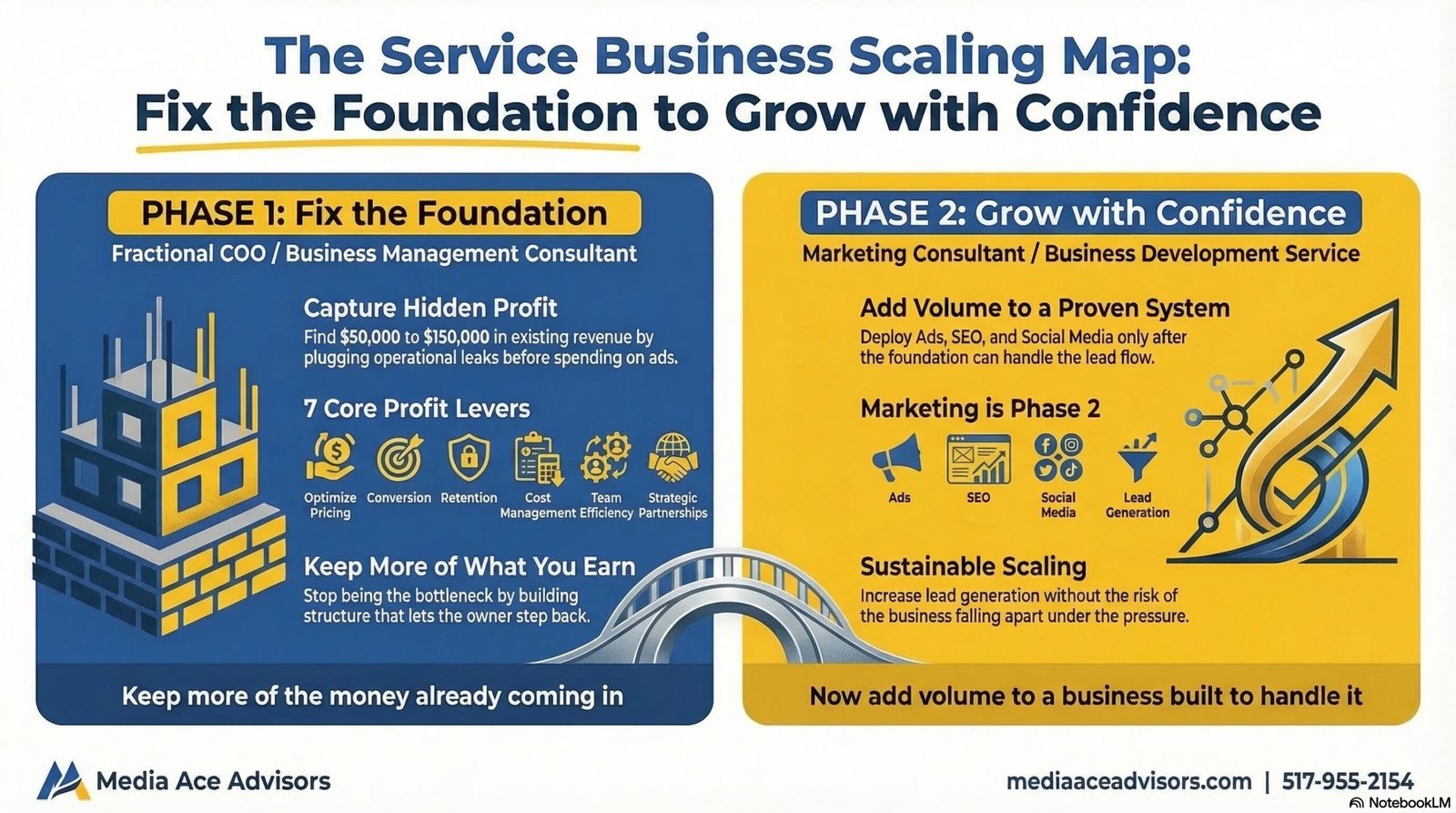
So what does a fractional COO actually do? They look at how you set your prices, how many people who call you actually become paying customers, how long those customers stay with you, what your real costs are, whether your team is doing the right work, and whether your systems can run without you standing over them. They find which one of those areas is costing you the most money and they fix it first. They are not a business coach telling you to set bigger goals and think positive. They are inside the business, hands on the numbers, measuring what changes.
The difference matters. A coach stands on the sideline. A fractional COO is on the field.
I spent 26 years in ICU and surgical nursing before I started doing this work. In the ICU, you do not walk into a patient’s room and start treatment before you know what is happening. You assess first. You check vitals. You look at what the monitors are showing you and what they are not showing you. Then you act. That is exactly how a good fractional COO works inside a business. Diagnosis before prescription. Every single time. For more on how management consulting has evolved as a profession, that background is worth understanding.
The fact that you are reading this already puts you ahead of most owners in your position. Most never stop long enough to ask whether their business needs a different kind of help than what they have been getting. They keep buying more of what hasn’t worked. You are asking a better question. That is where real change starts.
One thing worth being clear about. A fractional COO is not a marketing consultant. A marketing consultant helps you get more attention. A fractional COO helps you keep more of the money that attention brings in. It is not an internet marketing service. It is not a business development service. Those have their place, and they work well when the timing is right. But they belong in Phase 2. Phase 1 is making sure the business can handle growth before you add more to it.
What Does a Fractional COO Actually Examine Inside a Service Business?
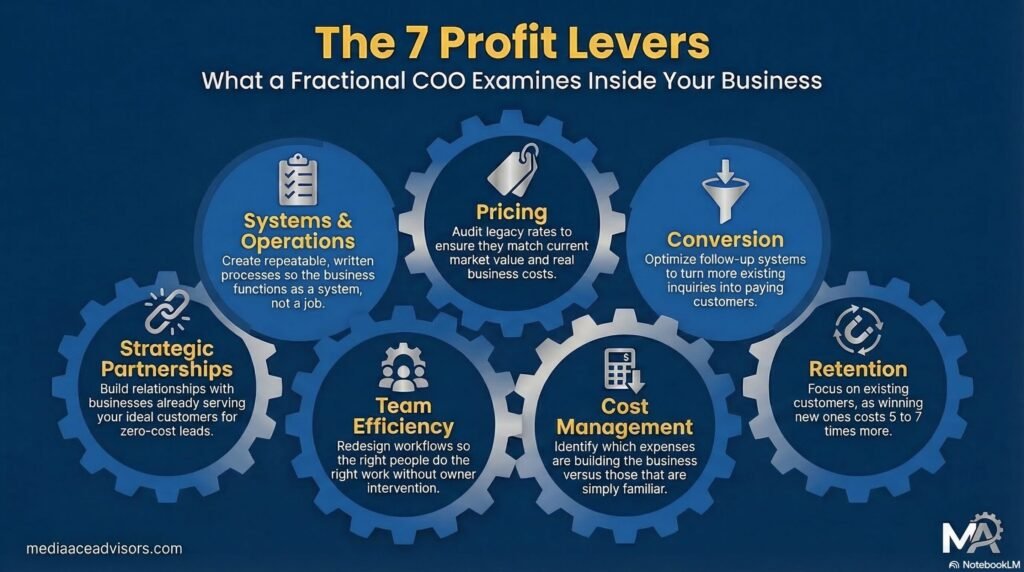
Direct answer: A fractional COO examines seven core areas that determine profitability in a service business: how you price your work, how many inquiries turn into paying customers, how long customers stay with you, what your real costs are, how your team spends their time, who else is already sending you business, and whether your systems can run without you. They find which area is losing the most money and fix it first, usually producing clear results within 90 days. For the full breakdown of all seven areas, the post on why small business growth stalls and the 7 profit levers that fix it goes deeper.
Here is what that looks like when you sit down and actually go through it. Whether you are pricing an HVAC install in East Lansing or a remodeling job in Mason, the math works the same way.
The first thing most fractional COOs look at is Pricing. Not because raising prices is always the answer, but because most service business owners set their prices years ago and have never looked at them with fresh eyes since. The number was picked when the business was smaller, when every job felt critical, when the competition felt bigger than it actually was. Over time that number became a habit. And a habit is not a pricing strategy. The 5-minute pricing audit walks through how to test whether your current rates match your real value.
The second area is Conversion, which is just a word for how many people who reach out to you actually become paying customers. This number is almost always lower than the owner thinks. And most of the time, the problem is not that the wrong people are calling. The problem is what happens after they call. The follow-up. The first conversation. The speed of the response. Small things that add up to big money left sitting there. The conversion formula for service businesses explains how to close that gap.
From there, a good fractional COO looks at Retention, meaning how long your customers stay and how often they come back. Winning a new customer costs five to seven times more than keeping one you already have. Every business that only chases new work while ignoring the people already in their world is spending the most money on the hardest path to revenue. The post on customer retention as a hidden revenue lever covers this in detail.
Cost Management comes next. This is not about cutting everything down to nothing. It is about knowing which costs are earning their keep and which ones are just there because they have been there for a while. There is a real difference between a cost that builds your business and a cost that just feels familiar. If you want a practical starting point, the year-end expense audit checklist shows you where to look.
Team Efficiency looks at whether the right people are doing the right work. In most small service businesses, the most expensive person is the owner. And the owner is usually doing work that does not need their level of skill. That is not a people problem. It is a design problem.
Strategic Partnerships examine who else is already working with your ideal customer before or after they need you. For many service businesses, this is the fastest path to new revenue with zero marketing cost. The full system for building these relationships is in the post on generating $100K in revenue without spending on marketing.
The seventh area is Systems and Operations. This is where the business finds out whether its processes are written down, repeatable, and capable of running without the owner watching every step. If the answer is no, the business is not quite a business yet. It is a very demanding job with a business name on the door. The post on why busy businesses stay broke without SOPs gets to the heart of this.
What Does This Actually Look Like Inside a Real Business?
Direct answer: In practice, a fractional COO starts with a conversation to find the gap between where the business is today and where the owner wants it to be. They identify the changes that need the least effort for the most financial impact and work through them one at a time.
Here is a pattern that shows up far more often than most business owners expect.
A trades business. Revenue around $1.5 million. The owner was working 60-hour weeks and had been for years. The team was busy. The phone was ringing. From the outside, everything looked like it was working. But the owner knew the real number. Revenue had grown, but what he actually took home had barely changed.
His first thought was to spend more on marketing. More calls, more jobs, more volume. But a closer look at the numbers told a different story. His conversion rate on incoming calls was sitting around 35%. For a business like his, it should have been closer to 55%. People were reaching out. They were interested. And then they were gone. The money was not missing at the front door. It was missing in the middle.
The fix was not a new ad campaign. It was a follow-up system that cost nothing to build and changed the direction of the business within 90 days. A pricing adjustment on two of his most popular services added another layer of recovered revenue on top of that.
He could fix anything a customer put in front of him. But nobody had ever shown him how to fix the business itself. The U.S. Small Business Administration has resources for owners in this position, and understanding the basics of business management is a solid starting point.
That same pattern shows up in professional services too. A healthcare practice doing well by every visible measure. Full schedule, strong reviews, growing reputation. But the owner was personally handling 70% of the patient work. Every time she tried to step back, revenue dipped. The answer was not hiring more staff. It was building a system that let the existing team deliver the same quality without the owner in every room. Within four months, she stepped back to three days a week and revenue held steady. That is what real structure looks like when it is built right.
How Much Does a Fractional COO Cost (And Is It Worth It for a Small Business)?
Most fractional COO engagements for service businesses run somewhere between $2,000 and $7,000 per month, depending on how many hours are involved and how deep the work goes. Compare that to a full-time COO salary of $150,000 to $250,000 per year plus benefits, and the math gets clear fast.
But here is the more important number. The right fractional COO should pay for themselves. If the work does not produce results that are bigger than the cost within the first 90 days, something is off with the engagement, not with the model. This is not an expense. It is a move that should show a return you can count. Research from Deloitte confirms that mid-sized businesses are increasingly turning to fractional executives as a cost-effective alternative to full-time hires.
What changes when the operations side of your business is handled well? The owner’s calendar opens up. Decisions come from real numbers instead of guesses. Customers stay longer and come back more often. The team knows what to do without someone directing every step. And for the first time in a long time, the revenue number and the bank account number start telling the same story. For a practical look at how this affects your bottom line, the post on how to improve profit margins without spending more on marketing is a good companion read.

What Are the Risks of Hiring a Fractional COO?
The biggest risk is not hiring a fractional COO. The biggest risk is hiring the wrong one.
Most fractional COO content you will find online is written for tech startups and software companies. A fractional COO who has never worked with a trades business, a healthcare practice, or a professional services firm will try to use frameworks that do not fit. They will talk about “sprints” and “product-market fit” and “burn rate” while you are trying to figure out why your best technician just gave two weeks’ notice. The diagnostic has to match the patient. The Bureau of Labor Statistics offers a useful overview of what management analysts and consultants actually do across industries.
The other risk worth naming is hiring someone who tells you what you want to hear instead of what you need to hear. A good fractional COO will challenge the way you have been doing things. They will show you where the real problems are, including problems you created. That is not comfortable. It is necessary. The ones who just agree with everything you say are the ones who charge you for months and change nothing. If you have ever struggled with saying no to customers or setting boundaries in your business, the post on why people pleasing costs six figures will hit home.
How Do You Know If You Need a Fractional COO?
There is no single test. But there are patterns that show up again and again in the service businesses that benefit the most from this kind of work.
The first pattern is the most common. Revenue is growing, but profit is flat. The top number looks good. The bottom number has not moved. More work is coming in, more is going out, and the space between effort and reward keeps getting wider.
The second one is quieter but just as costly. You said yes to a job last month that you knew was not worth it. You took it because you were afraid to say no. When pricing choices are driven by fear instead of strategy, the business pays for it every single time. For the psychology behind why this happens, the post on why smart business owners undercharge is worth your time.
The third shows up after a crisis. Your best employee quit and it took three months to recover, because nothing about how they did their job was written down. The knowledge walked out the door with them. That is not a hiring problem. That is a systems problem.
The fourth is something most owners already know but have not acted on. You have not raised your prices in over two years, even though your costs have gone up every quarter. The margin shrinks so slowly that it is easy to ignore. Until it is not.
The fifth is the one that matters most. If you got sick for two weeks, truly could not work, you do not know if the business would make it through. Not because the team is bad. Because the business was built around you, and without you it does not have a backbone. If that sounds familiar, the post on burnout symptoms and why business owners can’t rest their way to recovery speaks directly to this.
The sixth is one you might not think of as a warning sign, but it is. Your team asks you questions they should already know the answers to. Not because they are not good at their jobs. Because you are the only person who holds the key to how things get done. Every question that has to go through you is a signal that the business runs on your memory, not on a system. That is the bottleneck most owners never see because it feels like being needed.
If three or more of those patterns feel familiar, a conversation about what a fractional COO could do inside your business is worth 45 minutes of your time.
One honest note. If your business is under two years old or bringing in less than $250,000 a year, the priority right now is probably building a strong base of the right customers before working on operations. And if the business is in real financial trouble, not a tight month but genuine crisis, a fractional COO engagement is not the first call to make. A good advisor will tell you that up front, even when it means you are not ready to work together yet.
The Next Step for Service Businesses Ready to Stop Guessing
You just walked through what a fractional COO looks at in a first working session. The book interview I offer is exactly that kind of conversation. 45 minutes. No cost. No pitch.
During that conversation, I will ask about the gaps between where your business is right now and where you want it to be. I will share ideas based on what I see and show you where I believe the biggest opportunity is hiding. You will leave with something useful whether or not we ever work together.
Whether you manage a crew out of Lansing, run a practice in Grand Ledge, or handle service calls across Ingham and Eaton counties, the patterns inside these businesses follow the same map. And the money being left behind is almost always already there. It just has not been found yet.
You started this business because your work was worth more than a paycheck. The only question now is whether the business you built around that work is keeping up with the quality of what you deliver inside it. If you are not sure, that is not a problem. That is exactly what the conversation is for. The post on strategic planning for service businesses is a good place to start thinking about what comes next.
All because you can, doesn’t mean you should. But when you’re ready to build the business that matches the work you do, let’s have the conversation.
Frequently Asked Questions About Fractional COOs for Service Businesses
What is a fractional COO? A fractional COO is a senior operations leader who works inside your business part-time, usually 10 to 20 hours per month. They improve systems, pricing, customer retention, and overall profitability. Unlike a consultant who delivers a report and leaves, a fractional COO stays involved in the work and measures results over time.
What is the difference between a fractional COO and a full-time COO? A full-time COO is a salaried executive who works in the business every day. A fractional COO provides the same level of leadership on a flexible schedule. For service businesses earning $500K to $5M a year, the fractional model gives you executive-level operations help without the six-figure salary and benefits.
How much does a fractional COO cost for a small business? Most fractional COO engagements for service businesses range from $2,000 to $7,000 per month depending on scope. A good engagement should produce results that are larger than the cost within the first 90 days.
What is the difference between a fractional COO and a business coach? A business coach focuses on mindset, habits, and accountability. A fractional COO looks at the money and systems inside the business, finds where profit is being lost, and builds the structure to fix it. Both have value. But if your revenue is growing and your profit is not, the operational work comes first.
How do I know if my service business needs a fractional COO? If your revenue is growing but profit is flat, you cannot step away without things breaking, your pricing has not changed in years, or you spend most of your time doing the work instead of running the business, a fractional COO conversation is worth having.Can a fractional COO work with service businesses in Mid-Michigan? Yes. Media Ace Advisors works with service business owners in the Greater Lansing area, Grand Ledge, Mason, and across Mid-Michigan, including businesses in Ingham, Eaton, and Clinton counties. Remote engagements are available nationwide for service businesses earning $250,000 to $5 million a year.
About the Author
Ryan Herrst is a Platinum Elite Certified Profit Advisor, published author of Profit Foundation, and the founder of Media Ace Advisors in Grand Ledge, Michigan. He works with service business owners earning $250,000 to $5 million annually who are ready to find the hidden profit in their existing business without spending another dollar on marketing. His background in ICU and surgical nursing shapes a diagnostic, root-cause approach to business advisory work.
Contact Ryan at ryan@mediaaceadvisors.com or call 517-955-2154.
Website: https://www.mediaaceadvisors.com/